
Health & Wellness
« Older Entries | Newer Entries »Why I Don’t Care If The Health Care Bill Passes
[ Comments Off ]Posted on January 3, 2010 by admin in Health & Wellness, Politics
Sunday, January 3rd, 2010America’s health care system is neither healthy, caring, nor a system. But the Health Care Bill certainly will present someone with a bill.
|
When I’m in a hospital room, I usually have a |

I feel sorry for Barack Obama. Not only will history likely blame him for the long tail of the bank failures and bailouts for which the Bush administration was actually responsible, it will also likely blame him (because of the passage of the health care bill that has divided the country recently) for the continued malignancy that is our decrepit, bloated, and corrupt “health care system”. I put that phrase in quotes because I believe that – as the late Walter Cronkite once said – “America’s health care system is neither healthy, caring, nor a system“. While a bunch of Democratic congressmen who have nothing to worry about regarding their health care plans sit around patting themselves on the back for passing a health care bill that has supposedly been the dream of generations of Democratic politicians, the fact is that things won’t change for many, and we’ll still be left saddled with the most expensive and least effective health care in the developed world. The bill does NOTHING to fix what any intelligent person sees as the fundamental problem; it might in fact worsen it. Whether you describe the problem as being a result of government meddling and insurance, or as patient overuse of treatment because insurance will pay for it, or as a result of doctors requiring malpractice insurance, you will notice the word “insurance” keeps popping up. The fact is that the mind-boggling arrangements for billing and payment that exist today would be IMPOSSIBLE without the insurance industry supporting its piece of what really is an incredibly elaborate and blatant ponzi scheme being pulled off by an industry and a profession that operates under the ultimate smokescreen: an illusion of benevolence Read the rest of this entry »
Cyberchondria: Is It A Cold, A Flu, Or Airborne Ebola?
[ Comments Off ]Posted on October 23, 2009 by admin in Health & Wellness
Friday, October 23rd, 2009Using the Internet to diagnose yourself, it’s hard to tell if you have Adrenal Cancer, or just drank too much coffee.
 A virus is even creepier when viewed thru this Discovery Channel interactive |
As someone with a deranged work ethic who rarely gets sick, I tend to be pretty ignorant when it comes to commonplace things like how to have a cold or flu. Being this ignorant myself, I had NO IDEA that so many of my friends were health experts. Mention you have a few cold or flu symptoms and they all pull a clipboard out of thin air and start with the questions: “Are you getting plenty of fluids? Are you nauseous? Are you congested in your sinuses? It might be BACTERIAL, you know” and so on. Pretty soon I get convinced I have some airborne version of Ebola or something. And then I just get curious. So first of all, the cold vs flu debate: According to both the CDC and WebMD, there’s no way to tell which is which without a test in the early stages. They’re similar viruses, but colds tend to start slowly, last longer, and symptoms are usually confined to headaches and runny noses. A flu comes comes on much faster (the phrase “hits you like a truck” was used on several of the health sites I looked at) has deeper, broader symptoms that include body aches, nausea, etc. and can leave you fatigued for weeks after it’s run its course. Another big difference is that a flu is more likely to set you up for a bacterial infection like pneumonia, and not in the manner we’ve traditionally assumed. If you find this whole topic of viruses interesting, this Discovery Channel interactive wins the creepy award hands down, with its black backgrounds, hacker greens, crimson blood reds, and morbid ambient soundtrack. So just be careful researching health issues on the web. The fact that I’m still ill and a little slow in the brain as I type this, combined with about a half hour of light research, and suddenly I had a mild case of Cyberchondria developing. I mean, did you know that frequent urination and headache can be a sign of adrenal cancer? So be safe. Be sensible. Just get yourself to the doctor, and get a flu shot. Never mind that your shot is made from the diseased flesh of African Green Monkeys.
Placebo Effect Almost As Effective As Actual Drugs
[ Comments Off ]Posted on August 30, 2009 by admin in Health & Wellness
Sunday, August 30th, 2009But what fun would getting well be without long lists of bizarre side effects like explosive diarrhea, sleepwaling, and compulsive gambling?
This ad for the antidepressant Epiphanix has one of the longer lists of side effects we’ve seen |
In spite of the fact that I’m in retirement from a long and illustrious career of recreational drug use, when it comes to medicinal drug use, it’s almost impossible, for instance, to get me to take so much as an aspirin for a headache. I’m convinced that 90% of what ails us will fix itself, and that popping a pill every time we feel a little discomfort actually impairs our body’s ability to do its own repair work. Which is why I find it fascinating that research is showing that the placebo effect is mysteriously becoming more effective in clinical trials. Something we hear little about is the fact that drugs that go to market have, on occasion, barely beaten the placebo effect to get approved. This fairly recent development is inspiring new research into the mechanism behind the placebo effect, and how it might be put to work in place of drugs. Imagine a world without the common prescription drugs with the bizarre side-effects listed here. TV advertising would never be the same. Read the rest of this entry »
Trying To Eat An Organic Diet? Read Behind The Labels
[ Comments Off ]Posted on January 2, 2009 by admin in Health & Wellness
Friday, January 2nd, 2009Remember: If It’s 95% Organic, It Can Still Be 5% Crap
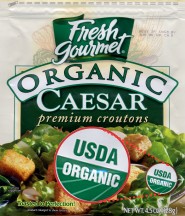 When people start talking about diet and how it affects your health, I’m reminded that I’ve been very lucky. I grew up in a town that has a lot of fresh produce markets and decent restaurants, so my earliest experiences with food were that fresh was good, and cooking from scratch was fun. As a result I eat very little processed food, without really even thinking about it. It doesn’t seem like rocket science, and I’m convinced that eating this way has kept me much healthier than a lot of people my age who habitually plugged into the habit of using “productized” meats and vegetables and prepared commercial sauces. If you’re interested in pursuing a less-manufactured diet, it’s not so hard. Instead of looking for labels that say “Organic” or “All Natural”, look for a LACK of labels. I was reminded of this recently when I bought a bag of commercial Caesar salad croutons (Fresh Gourmet Organic Caesar Premium Croutons, to be specific). I really wasn’t paying much attention when I selected them. Out of the 20+ choices in my face at the local supermarket, I simply chose the one that looked the least “flavored”. I still didn’t look at the package until after I put them in a salad and nearly gagged on the chemical taste of the first crunch. Upon looking at the package, I was startled by the emphasis on “Organic”, including the “USDA Organic” stamp (see photo). Every ingredient in the “Ingredients” list had the adjective “organic” in front of it, yet this stuff tasted like a salt-soaked chemical bomb. What was up? Well it turns out “USDA Organic” means that 95% of the ingredients are organically produced. You don’t have to be a chef or a scientist to understand that if something is 5% crap, there’s a pretty good chance it’ll be crappy. If you’re going to rely on labels, this quick Consumer Reports summary might help you make some better decisions.
Unnecessary Medical Treatment
[ Comments Off ]Posted on December 26, 2008 by admin in Health & Wellness
Friday, December 26th, 2008Maybe Doctors Should Just Stop Cutting It Out
 One of the central reasons for my general distrust of contemporary American medicine has been a common-sense hunch that there’s a lot of unnecessary treatment and billing going on because of the fact that insurance companies are in fact essentially investment companies, and hospitals’ revenue is heavily dependent on insurance, which leads to an unhealthy business model (see this Independent Review report 64KB, PDF). Understanding how hospitals make money is no simple topic, but one can reasonably deduct that a non-vital procedure will be more likely to be recommended if the patient has insurance. I’ve had first-hand experience with this: I once had a severe laceration on my arm that ER staff thought may have nicked a tendon. After moving up the chain of authority to the plastic surgeon, they were fully convinced I needed surgery. That is, until the plastic surgeon was flipping through my paperwork and realized I didn’t have insurance (I was looking over his shoulder) and took another look. Suddenly he became convinced that a simple sling would suffice, since “sometimes these injuries almost do better healing on their own”. Although I have always assumed there were a lot of unnecessary procedures, I was surprised upon doing a little web searching to see just how prevalent this is. Depending on the source, figures range from a more alarmist suggestion that 60% of all surgeries are medically unjustified to a more conservative figure of 25%. Adding to this is the pharmaceutical industry’s almost homicidal drive to push drugs to market. This article, for instance, suggests that unneeded prescriptions cost the nation’s public and private health plans as much as $50 billion annually . And more specifically close to home for me, a Canadian study found that over 41% of prescriptions for NSAID’s (non-steroidal anti-inflammatory drugs) were unnecessary. I’ll have more on the topic of anti-inflammatory agents in an upcoming piece; I have a firm belief that a wide range of conditions encompassing joint pain, immune problems, and inflamed tissue all relate to some simple diet issues.