
Confessions Of A Plum Market Paparazzi
[ Comments Off ]Posted on October 28, 2010 by admin in Editorial & Opinion
Thursday, October 28th, 2010OR: How taking innocuous photos at Plum Market can lead to veiled accusations of corporate espionage.
 One of the nice displays at Plum Market. Too bad I’ll never lay eyes on them again. |
I had an interesting experience today which – in an indirect way – highlighted the corporate personhood vs individual personhood rights issue. The irony being the fact that it was a fellow personhood that was attempting to assert the corporation’s “rights”, ultimately at some small expense to the corporation. Let me explain. I do a lot of random small business consulting that runs the gamut from point of sale and display advice to web marketing development. Because of my work, and simply because of my nature, I am constantly – in fact almost compulsively – analyzing products, packaging, advertisements, and retail layouts. Today, for the first time amongst many visits to retail stores, I was more or less accused of being a possible corporate spy. I was in a local Plum Market, admiring the spacious, clean displays in their wine section. I ended up taking a few photos for two reasons. First of all, I wanted to show their wine racks to a friend who’s trying to figure out an interesting way to outfit his growing wine cellar. Although Plum’s display racks presented wines in a reasonably attractive way, they also frankly looked like they would be fairly cheap, and suit my friend’s simplistic modern tastes. The other reason I was taking a few photos was because I simply wanted to make a visual note of what I considered less-than-ideal display design that while visually appealing, was oddly flawed in a few ways. I was in fact doing casual research that would probably influence the ideas I would share with a client. It was after I had taken a few photos that an employee walked up to me and said “Excuse me, I noticed you were taking photos”. The camera was already back in my pocket at this point, but I had nothing to hide, and said “Yes, I was. Is that a problem?”, to which he replied: “Well, that depends on WHY you were taking photographs. Are you a competitor?” I replied – quite honestly – that no, I was not a competitor. In spite of being rather annoyed by his accusatory tone, I maintained a brief, courteous dialogue with him in which he explained that “lots of our competitors come in to copy our model, we’re a very successful operation”. There were a number of things that raised my hackles about this interaction. First of all, the simple fact that he approached me with suspicion rather than as a customer. I can understand (within reason) a retail operation’s concern about corporate espionage, but it was immediately obvious that this man’s reason for concern was rather nebulous, and that he was sort of justifying his low-key accusation on the fly. It’s important to note that I’m a fairly distinctive looking person with white hair, wearing a fairly conspicuous vintage grey outfit, taking a couple of pictures, making absolutely no effort to hide the fact. Wouldn’t a “spy” be wearing sweats and discreetly taking pictures with their iPhone, so they could transmit their covert surveillance photos back to headquarters? I’m not the first to raise this question; there are plenty of question & answer posts out there in which people discuss the same topic. And I don’t question a retail store’s right to state a “no photos” policy, as long as they post it. But all the arguments against taking photos while you shop don’t fly with me. Almost anything one could “steal” (i.e., visual presentation) in this context certainly doesn’t require a camera to copy, and if in fact the ideas being “stolen” are somehow a legitimate legal trademark of the store and they get copied and implemented somewhere else, the business can pursue legal action. This article sums up some of my thinking, but this goes deeper for me. Later in the day I asked a barrista at a local cafe how they’d respond to a person randomly taking photos in their cafe, and they said they’d be concerned. When I asked why, they fumbled at a similar answer about competitors. To me, this smacks more of knee-jerk, post 9/11, culture of fear reactions than rational policy. Because I’d bet this month’s Google AdSense revenue that these same stores will let Google take the same kinds of photos without batting a lash, without Google having to resort to these devious methods recommended by The Consumerist. Because you know, a person working for a corporation can’t trust a person, but they can trust another corporation. Watch for a future piece on this topic; I plan to test it out in a variety of stores and present the results. I’d love to hear others’ thoughts on this though.
Magic Mirrors, Pixelated Pics, And A Point & Punch Camera
[ Comments Off ]Posted on November 5, 2009 by admin in Technology
Thursday, November 5th, 2009Some fun and interesting technology for creating unusual pixelated images.
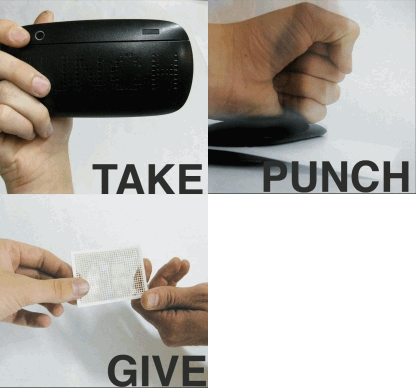 I have a minor fetish for slick but slightly Rube Goldbergian technology that is utilized to achieve simple aims, which is why I love the idea of the punch camera, which captures an image, arranges little pins internally, and then lets the user punch the camera like a stapler to create a sort of dot-matrix/hole-punch rendition of the image. The camera is, alas, only a concept which was conceived by bay area design student Matty Martin. See the rest of Matty’s portfolio here. The punch camera concept reminded me of a sculptural design project by Daniel Bozen called Shiny Balls Mirror, which was one of a series of interactive sculptures which use a camera to capture whatever is in front of the sculpture to re-arrange objects to reflect the image back at the viewer in real time. I think Matty and Danny should talk to each other about an exhibit. See more of Danny’s sculptures here. And as is inevitably the case for search addicts like myself, while tracking down these links to share, I accidentally ran across this crazy Image Mosaic Generator, which lets you upload a photo, and then converts the image to a pixelated version with images that it automatically scours from the web. The results don’t look too impressive until you zoom in on the image, and realize how varied the images are, and how they were automatically snagged from the web and assembled into a single image. There’s an example below. Read the rest of this entry »
Real Tiny Cities, Tiny Real Cities
[ Comments Off ]Posted on March 12, 2009 by admin in Popular Media
Thursday, March 12th, 2009Fun with miniatures and tilt shift photography.
You may have heard of tilt-shift photography before, or at least seen examples of it. What is our fascination with tiny things? While some people spend all their time making tiny cities that are remarkably realistic, others spend all their time making real cities look unrealistic. That first link is the Miniatur Wunderland in Hamburg Germany, the second is an actual photo of London manipulated to look like a miniature. The best examples of this kind of work use actual optics to achieve the effect, but if you want to try your hand at it without the investment, there are plenty of tilt-shift Photoshop tutorials , and now there’s even an iPhone app. The online tool at TiltShiftMaker.com will also let you upload your own photos and add the effect. Tilt shift can be even more fun with video; the clip at left is from Sydney Australia’s Mardi Gras 2009. It was created by Sydney-based photographer Keith Loutit, who has more clips on Vimeo. One of my favorites is Helpless, in which Greenpeace activists and sand sculptors build a 17-metre sculpture of a fin whale on Sydney’s Bondi Beach to send a message to the Japanese Government in protest of its controversial whaling program. For more still image examples see this collection at Smashing Magazine .
Discovering “Disfarmer: A Portrait of America”
[ Comments Off ]Posted on February 19, 2009 by admin in Popular Media
Thursday, February 19th, 2009A fascinating and amusing story about an enigmatic photographer
I have an amusing story about how I became familiar with the documentary Disfarmer: A Portrait of America, which is the amazing story of how the work of depression era photographer Michael Disfarmer was discovered. One of his photos captured my eye on a Turkish link site, of all places, and I made a mental note to take a closer look later. Later that day, while looking at the artwork of an old friend (Hava Gurevich) I noticed that of all the odd coincidences, she was involved with the very same project. Although I’m not an active photographer at this point, I’ve loved photography all my life. I had a Kodak 620 camera when I was six; just ask me for samples of my work…that may have been the apex of my career! In any case, I’ve always just sort of laughed off the question of whether or not it’s “art”; just look at work by bigger names like Ansel Adams, Imogen Cunningham, Edward Weston, or Hiroshi Sugimoto, and it becomes a moot point. That’s why it was an incredible pleasure to stumble upon the work of Michael Disfarmer. I’ve always been fascinated with depression era and WWII photos of the sort you might find on the Library of Congress’ Farm Security Administration site or the FDR Library site, but Michael Disfarmer’s photos capture an incredible inner something in almost every single subject. They’re powerful, magical, and many other words that won’t begin to do the images justice. The clip featured here is a one-minute teaser for the film that is slated for release this fall; you can catch another trailer and a 20-minute preview on Vimeo.
Earth From Above – Photos By Yann Arthus-Bertrand
[ Comments Off ]Posted on October 7, 2008 by admin in Clean & Green
Tuesday, October 7th, 2008The big picture. Literally.
 On those pesky days when the world begins plunging into financial chaos and despair, it’s probably a good idea to try to remember we live on a REALLY big planet, and very little of it is made of money. As imaginary trillions turn into worthless pieces of paper, maybe some of those imaginary trillionaires will take a break from trying to horde the remnants of their empires, and take a look around. French photographer Yann Arthus-Bertrand has been looking around the world since 1994. In an attempt to inspire people to think globally about sustainable living, he has taken astoundingly beautiful photographs from the air in over 150 countries. These are not simply nature photographs; often the subjects are the sad results of industry, technology, or war. Who would think, for instance, that the waste produced by a copper mine could be beautiful? Referring to the resulting collection of images, Arthus-Bertrand suggests: “Though it invites us all to take our own responsibilities, this testimony remains resolutely optimistic. Each portrait, be it of the Earth or its inhabitants, aims at showing the best in order to appeal to what is best in us. For the will to protect is indeed strongest towards that which one has learnt to understand and love.” Which I guess will be a bit of a problem for those who have primarily “learnt to understand and love” their wealth.