
Fame & Fugliness
[ 1 Comment ]Posted on February 17, 2010 by admin in Lifestyle & Culture
Wednesday, February 17th, 2010Is ugly the new hot?
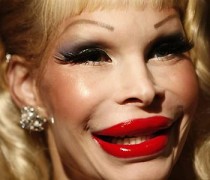 It’s been said that beauty is in the eye of the beerholder, but you may find a sort of hideous beauty in these photographs by Phillip Toledano, even if you’re not holding a beer. The photos are from a series exploring the strangely compelling appearances of individuals that have undergone what many would describe as botched or excessive cosmetic surgery. Part of what gives the images their power is how they reference images from art that you may already be familiar with, as in the case of this image, which suggests both Portrait of a Young Woman in a Turban and the Death of Marat. On his web site, Toledano asks if – as a culture – we are “…creating a new kind of beauty. An amalgam of surgery, art, and popular culture? And if so, are the results the vanguard of human induced evolution?” I’d have to say “no”, in this case. I’m perpetually perplexed by how perfectly decent-looking people go to such great lengths to be more attractive, and when all is said and done end up looking literally monstrous, as in the case of Internet meme celebrity Jocelyn Wildenstein, or just a little more fake and not any more attractive (though a lot more famous!) as in the case of someone like Heidi Montag. And for me, the fact that a desire for fame is what often drives these surgical compulsions is especially ironic, when being “ugly” can be such a draw in itself. As evidence, just take a look at Nerve.com’s 20 Sexiest Ugly People or Ravi Vora’s Ugly Actors You Know And Love. There’s even a modeling agency that specializes in ugly called – aptly enough – Ugly. I’ve personally always been a little partial to the “ugliness” of Sandra Bernhard, Helena Bonham Carter, Bai Ling, and more recently Yolandi Visser. To me, it’s the exaggerated features of the sort Fellini relied on (see the book Fellini’s Faces
The Kindness Economy
[ Comments Off ]Posted on February 12, 2010 by admin in Lifestyle & Culture
Friday, February 12th, 2010The new bestseller that you and I can write every day.
 I’m currently putting the finishing touches on a short book based on the idea of The Kindness Economy. It started as a friendly joke with a few friends; we were comparing notes on how people seem to have slowly become ruder and more self-centered with every passing day over the past couple decades. Our idea was that if you make a little investment in being kinder ever day – hold a door, let someone go first, say excuse me – it would sort of make a deposit into the “Kindness Economy” that would help build up the “Kindess Supply”. This idea has helped me grow a little bit as a person, but it occurred to me after a while that maybe there was something to it. Over the past decade I’ve not only done a lot of work to try to improve myself as person, I’ve been learning a lot about how to and how not to run a business. One thing I noticed at some point was that there was a marked difference in the style of how business people of different ages seemed to approach running their business. At this point I’d put the marker around 55 years old and up, and it’s a simple difference: business people under that age right now are much more likely to be motivated more strictly by profit, and people over that age are much more likely to motivated by a deeper sense of value and community. I am of course speaking anecdotally and in broad strokes, but I’ve noticed that the “old school” model includes a lot more personal touches of “going the extra mile” by throwing in simple courtesies of service, and not treating customer care simply as a way of retaining disgruntled customers, but as a way of building new ones. It also includes the idea of building business that is of value not only to shareholders and investors, but also people like employees, customers, and the citizens of the community from which the business derives its revenue. I’m old enough myself to have watched the general sense of prosperity in America dwindle from a high point in the 60′s to the current sense of impending econopocalypse. Concurrent with this I’ve noticed this trend of people seeming less courteous as time passes, and I can’t help feeling that there’s some kind of connection. We could enter some broad sociological discourse at this point about how prosperity and courtesy in America were impacted by the Great Depression and the two World Wars, and how the generations of that era were forced into a sense of community and later thrived on the post war prosperity, but how about this time we skip the whole financial collapse and global conflict part, and just get back to being kinder for the sense of comfort and prosperity it brings all on its own? Read the rest of this entry »
Reality Is A Life Or Death Situation
[ Comments Off ]Posted on February 6, 2010 by admin in Lifestyle & Culture
Saturday, February 6th, 2010It’s interesting that in spite of the fact that one of the few things you can count on about this planet is that no-one gets out alive, no-one seems to have advice for how to die well.
  I’ve always had a sneaking suspicion that this one only works for Tibetans |
It’s interesting that thanks to the self help industry we have so many books at our disposal that tell us how to live, but scant few on how to die. Sure, there’s a plethora of paperbacks devoted to grieving, loss, and dying, but that’s still about how to live, albeit while watching someone else die. A quick Google search of the phrase “how to die” turns up the Deathclock and a bunch of tips on suicide, but even suicide is a conscious act of the living, not a process of dying. You also find things like the book How to Die in the Outdoors: 100 Interesting Ways
America: Land Of The Fleeced & Home Of The Brazen
[ 1 Comment ]Posted on January 24, 2010 by admin in Lifestyle & Culture
Sunday, January 24th, 2010I’m not sure I know how to live in this country any more, they’ve changed too many rules. Maybe we need to start making our own.
 I’m not so sure I know how to live in America any more. When it comes to politics, I’ve always been the sort who’s in favor of a mixed economy, believing that a balance of free markets and social programs is the best choice for governing. Regardless of the finer points of my political opinions, I got good grades in Civics class, and was properly indoctrinated as a US citizen growing up. Although what I’m about to say is going to sound like it’s partisan and politically motivated, it’s really not. It’s about lifestyle, and responsibility to my fellow citizens and financial agreements. Like many, I’ve had some credit issues here and there, but as we’ve learned recently, lenders are kind of like drug dealers, offering a magical solution to all your problems, without advising you of the long term dangers of the solution they provide. But by and large, I’ve always believed in hard work and paying my bills and taxes on time. The entire fabric of my basic moral fiber as a citizen of the world’s leading capitalist democracy has been slowly unraveling for a while though, and I find it harder and harder to keep living like the American I thought I was. For me it all started when 19 Saudis engaged in terrorist acts against the US, and the administration at the time perplexed the world by responding to the attacks by starting wars in Afghanistan and Iraq. And as if going against a long-standing tradition of not engaging in wars of aggression wasn’t bad enough, it was clear that a large part of that administration’s motive at the time was personal financial benefit, and a desire to privatize the military, so other “disaster capitalists” could do the same. Check out Naomi Klein’s The Shock Doctrine

The Body Electric: Chi Loves Me… Chi Loves Me Not…
[ 1 Comment ]Posted on January 19, 2010 by admin in Lifestyle & Culture
Tuesday, January 19th, 2010Musings on the Pauli Effect, humans as batteries, tantrism and chi, and people who seem to get an unnatural charge out of life.
 Maybe you’ve just seen the movie “Powder” a few too many times. |
Are you or someone you know the sort of person who can’t wear watches, seems to regularly “blow out” light bulbs or other electronic devices, or routinely has street lights go off or on when you pass by? Maybe you’re a victim of the Pauli Effect. Or maybe you’ve just seen the movie Powder

