
« Super Bowl Sunday: What’s REALLY In That Seven Layer Dip? | Home | Normal People vs. The People vs. George Lucas »
Reality Is A Life Or Death Situation
Topics: Lifestyle & Culture | Add A CommentBy admin | February 6, 2010
It’s interesting that in spite of the fact that one of the few things you can count on about this planet is that no-one gets out alive, no-one seems to have advice for how to die well.
  I’ve always had a sneaking suspicion that this one only works for Tibetans |
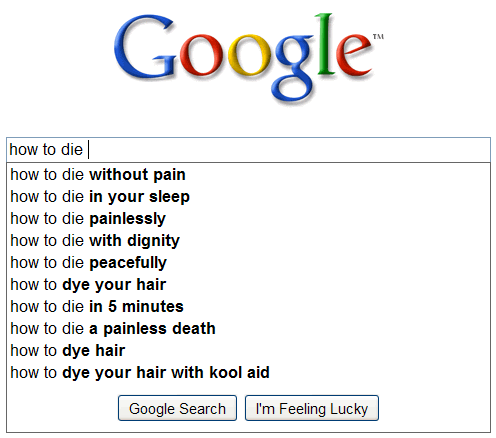
It’s interesting that thanks to the self help industry we have so many books at our disposal that tell us how to live, but scant few on how to die. Sure, there’s a plethora of paperbacks devoted to grieving, loss, and dying, but that’s still about how to live, albeit while watching someone else die. A quick Google search of the phrase “how to die” turns up the Deathclock and a bunch of tips on suicide, but even suicide is a conscious act of the living, not a process of dying. You also find things like the book How to Die in the Outdoors: 100 Interesting Ways
from her parrish during the holiday season, which was when it became apparent that she might have quite a struggle ahead. She told him that she thought maybe she just wanted to die. She told me that he said something to the effect of “You can’t do that now Dorothy, your family needs you to stay with them, especially at this special time of the year“. I said “Well THAT sounds like a bunch of malarkey, what do YOU think?” She chuckled and agreed. But all along the rather difficult road of watching her bounce back and fade away repeatedly (she’s a feisty old gal), I’ve been troubled because I know she really IS only hanging on for others; she’s as much as told me so. And that saddens and troubles me more than losing her ever could; this should be HER time. And it should be simple. She’s had 82 years to enjoy life with her insightful, genuinely loving nature, and her seemingly indestructable humor. She should be allowed to move on now with grace if she wants or needs to. And she should have some idea of how to do so. I ran across a couple of interesting articles on this topic as I did some superficial research while I wrote this. One was How to die — a physician’s last lesson, in which a doctor explains how their father, also a doctor, went about dying with relative peace. It was definitely worthy of note that with two doctors involved in the decision-making process, medical treatment was not involved. I also ran across a rather lengthy but interesting piece with New York Times health reporter and author Jane Brody called How to Die Well in America. One simple thing that jumped out at me amongst a lot of other insights was when she pointed out that we “…shield our children from death. In the old days, people died at home. That was the most common place people died, and everybody was around for all ages. Nobody was spared…” I really hope that when my time comes, dying is at least as easy to do as living has been, which has been pretty dealable for the most part.