
What If America’s Highways Were One Big Solar Panel?
[ 4 Comments ]Posted on September 23, 2010 by admin in Clean & Green, Technology
Thursday, September 23rd, 2010Solar Roadways has an idea that could solve several of America’s energy and infrastructure problems at once, and revolutionize energy and transportation.
 Okay. So you’re not quite ready to give up your gas guzzling FUV for some pansy little electric just yet. So how about we make the ROADS electric? That’s the rather brilliant idea behind Solar Roadways’ “Intelligent Highway” prototype (video below). The basic idea is that we have 2.73 million miles of paved road in America that just sits there getting driven on. So why not make it a solar grid? We’d produce three times more energy than the country needs, and since the roads go everywhere, including right to your house, why not deliver the electricity intelligently throughout the grid too, eliminating the need for much of the country’s hardwired power distribution? With the erratically skyrocketing costs of asphalt, this idea seems like a no-brainer. Solar Roadways’ highway would be built with – get this – glass, and utilize all sorts of extra features including built-in LED’s that can display virtually any message you like. Personally I think even if the material were quite a bit “dumber”, and only collected and distributed electricity, this would be a brilliant plan for America’s infrastructure. Although there’s a little irony in the fact that much like petroleum, one of the plan’s central materials is plentiful in Saudi Arabia. Down the road we may lament our dependence on foreign sand. But seriously. This is GENIUS. Why hasn’t it gotten more press? Consider giving them a vote to help them get funding from GE. Read the rest of this entry »
Big Oil’s Proposition 23: Don’t Blow This One, California
[ Comments Off ]Posted on September 21, 2010 by admin in Clean & Green
Tuesday, September 21st, 2010Hey California, even if YOU don’t care, think about the rest of us. We’re downwind you know. We want to see the sunshine while we build our poop-powered cars made of hemp.
 Don’t do it California. Don’t let this Proposition 23 thing go through. I feel odd throwing in my two cents, because I’m not a resident so I can’t even vote on it, but you’ve proven your obliviousness to your own well-being before, so I feel it’s my civic duty to address the issue, even if I do live three thousand miles away. Maybe you’ll be more self-interested on this one if enough outsiders rant about it. If you’re not aware of what Proposition 23 is about, here’s the nutshell version: two Texas oil companies – Tesoro Corp. and Valero Energy Corp. – are spending over $100 million dollars to try to roll back California’s visionary emissions reduction plans, which were intended to limit California’s pollution levels in 2020 to what they were in 1990. The energy companies’ justification? They claim that the emission control legislation has caused California’s double-digit unemployment. Even if this were true – and it isn’t; there are plenty of states with double-digit unemployment that don’t have forward-thinking emission control legislation – what kind of effed up logic is THAT? “Honey, I know it’s sad that the kids can’t play outside today for fear of being asphyxiated by the sooty, mustard brown air, but at least we have JOBS…” C’mon California, get it together. Don’t let a bunch of rich, fossil-fuel Texans tell you how to run your state. Use your unemployment as inspiration to INNOVATE. And even if you don’t care enough about your own state to act on this, think about the rest of us. Your air blows our way a lot. We want to be able to see the sunshine while we build our poop-powered cars made of hemp.
Let Me Tell You ’bout The Bats And The Bees
[ Comments Off ]Posted on September 6, 2010 by admin in Clean & Green
Monday, September 6th, 2010Because this is one environmental topic that should bee generating more buzz.
 Yes, bats pollinate too. Source |
You may have heard about the massive die-off of bees caused by Colony Collapse Disorder, or the possible extinction of a number of species of bats caused by White Nose Syndrome. But have you thought about the ramifications or kept up to date on the causes? Depending on the source, the cost to agribusiness resulting from continued bee die-offs ranges from $14 billion to $92 billion annually. And if the bats continued dying? Some species of bats can eat as many as 3,000 insects nightly, mosquitoes being common prey. To frame that more dramatically: the colony of approximately 20 million free-tailed bats at Bracken Cave, Texas, eats up to a quarter-million pounds of insects in a single night. Or put another way, the weight of 462,962 6oz cans of Deep Woods Off
Wheeling & Dealing In Michigan – A Hemp Based Auto Industry?
[ 2 Comments ]Posted on September 1, 2010 by admin in Clean & Green
Wednesday, September 1st, 2010Could legalized hemp solve Michigan’s economic woes? Even if it didn’t, the recreational use would sure take the edge off Michiganders’ trademark up-tightness.
 I think the solution for Michigan’s economic woes is sitting right under our noses. Or perhaps in someone’s bong. You may have heard recently about the Kestrel, a new electric car with a biocomposite body being engineered by Motive Industries of Canada. What do they mean by biocomposite? Hemp. You may already know that hemp is a versatile material for manufacturing, but you may not be aware of hemp’s connection with the very origins of the auto industry. It seems that Henry Ford not only originally envisioned a world full of automobiles fueled by ethanol (with hemp as one of the primary sources of biomass) but even built a hemp composite car all the way back in the 1930′s . So weed and wheels have a long history. Given Michigan’s recent foray into legalizing medical marijuana, maybe the state should just go all the way and make a commitment to cannabis as an industry. The broad industrial uses are obvious, the medical benefits are becoming widely accepted, and if they then just decriminalized the recreational usage of the stuff, we’d have a powerful tool for dealing with the typical Michigander’s trademark up-tightness. Just be careful with your wheeling and dealing, even if you have a license to do both.
The Biomethane Industry Is Booming
[ Comments Off ]Posted on August 20, 2010 by admin in Clean & Green
Friday, August 20th, 2010Toilet powered Volkswagens, dual fuel trucks, and refugee camps powered by porta-potties. If we could just get all the politicians that are in the pocket of big oil to pull their heads out of their rears, we could double our alternative energy resources.
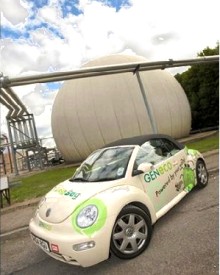 This little baby gets about 143 MPT (miles per toilet) |
When I was in grade school, I would – as I know many young boys probably still do – joke about how if we could just harness my friend’s seemingly never-ending compulsion to break wind, the world’s energy problems would be solved. As I grew older, this joke found new life in reference to the hot air of politicians who promote the myth of hope for America’s energy independence (see Robert Bryce’s Gusher of Lies