
Lifestyle & Culture
« Older Entries | Newer Entries »Is The Occupy Movement Dead?
[ Comments Off ]Posted on February 26, 2012 by admin in Lifestyle & Culture
Sunday, February 26th, 2012Not likely. But it probably needs to get itself off the ropes. And though it’s no longer in tents, it might still get intense. Remember: it’s the banks, stupid.
 Perhaps the only thing more tedious than a roomful of liberal intellectuals endlessly debating the world’s problems is a roomful of moderate Republicans, Tea Partiers, Libertarians, socialists, anarchists AND liberal intellectuals doing the same thing. And if you attend an Occupy-related meeting or assembly anywhere across the country, there’s a good chance that you will run into this phenomena. It’s equally likely that you will encounter a similar mix of people having a surprisingly productive and efficient meeting, using methods that will seem strange to most people. And no, I’m not talking about twinkle fingers; as one of the folks involved in some re-organization of Occupy Ann Arbor, I attend a lot of meetings and events, and haven’t seen many twinkle fingers since December. No, I’m talking about consensual decision making that may borrow both from the most ancient of methods – like the Greek Forum – to cutting edge ideas like Open Space, which also is used by organizations that range from AT&T and Rockport to Israeli/Palestinian peace organizers.
What I DO still see a lot of though is opinionating. And personal irresponsibility. And confusion. Last fall a former Ann Arborite – writing for the National Review – said that “an Occupy Ann Arbor is like a special ballet company, set aside for thin people.” Nothing could really be farther from the truth; this town is so conservative that the real problem has been getting enough people present to actually occupy anything in a noticeable fashion. And when they do get together in any notable numbers – amongst the self-identified Occupy groups in the area, there is a strange mix of factionalism and solidarity – there will often be a strange result. They will suddenly realize once again that they agree on a bunch of things, but then get mired in debate about what to do and how to do it. This perplexed me for months, and then I finally came to understand a few things. Read the rest of this entry »
Seven BEGINNING Of The World Ideas For 2012
[ Comments Off ]Posted on January 3, 2012 by admin in Lifestyle & Culture
Tuesday, January 3rd, 2012If we’re all expecting the end of the world as we know it, we might as well plan the new one.
 Okay, we’ve all had our fun pondering the end of life as we know it this year. I even took a humorous stab at it just the other day. I guess we needed to get it out of our systems again. I mean, it’s been over ten long years since the last time we got all nutty about the impending apocalypse. Personally, I’m of the opinion that this yearning for a dramatic end of the world scenario is driven largely by the collective unconscious guilt of the human race. On the one hand, the guilt that wealthy elites unconsciously feel, knowing that the tablet device their ten year old is watching Disney movies on as they fly to a tropical retreat was made by the cracked and bleeding fingers of ANOTHER ten year old, half a world away. A ten year old that gets paid a dollar a day so that the company that made the tablet can “retain the talent” of the overpaid CEO that was largely responsible for taking that dollar-a-day kid’s crappy job away from some former middle class American because they got paid 20 times more for it. And on the OTHER hand, the collective guilt fueled by the laziness and apathy of that same former middle-class American, who didn’t vote, didn’t pay attention while their country got gutted by robber barons, and instead sat around ordering out for pizza and watching “reality TV” and cable news while their home got repossessed and the cost of education skyrocketed so high that their kids will be doomed to the same second-rate first-world life that they are. Do I sound cynical? I’m not. In fact, I figure if we DO finally have to face the end of the world this year, that just means we have opportunities to create a new one. And the ball is already in motion. From the recent massive protests in Russia, to the Occupy, Tea Party, and “think local” movements in America, to the “Arab Spring”, regular people all over the world are demanding a better world. I think we can make one. How about you? Below is my starter wish list. Feel free to chime in or tell me what an idiotic Utopian I am. Read the rest of this entry »
The Horrors of Cheese
[ Comments Off ]Posted on December 11, 2011 by admin in Lifestyle & Culture
Sunday, December 11th, 2011What’s in a name? Well, a LOT, when the name is something like “Stinking Bishop” Never mind your milk, these cheese facts will make your BLOOD curdle.
 As much as I love cheese, I’ve always figured the first person that ate it must have been in the same frame of mind as the first guy that ate lobster. You know, the old joke about how hungry he must have been to be walking down a beach, see a lobster, and think to himself “Mmmm! That looks yummy!” There’s something similar going on with the cheese story. Sure, we all derived our first nourishment and comfort from the milk of our mothers’ bosoms, but let’s face it. Once you’ve moved on from all that, it’s kind of a weird stretch to look at a cow’s dangling doohickeys and decide to give it a go. And the weirder part is that having done so, someone then had to leave the results of their efforts laying around long enough to curdle, look at it and smell it, and say to themselves “Mmmmm. This will be DELISH”. A rather disturbing series of choices, if you ask me. I mean, while it’s not THAT hard to rationalize the whole milking of mammals thing, even the pastoral tribes of East Africa, who subsist only on the milk and blood of their herds (yup, you read that right, the BLOOD), wouldn’t THINK of eating cheese. And apparently never have; they don’t even have a word for the stuff. Similarly, it’s only in certain parts of Asia that people eat cheese. The distaste for cheese amongst Asian people can in fact be fairly intense; for instance, if you want to make your Japanese guests make a subtle “vurp” face, bring out the cheese platter. I learned this years ago when I lived in San Francisco. I often took the bus up Columbus Avenue with a Japanese friend I worked with. One day, I made the observation that as the bus progressed through Chinatown and more Asian passengers boarded, it smelled more and more like seafood with each passing block. He asked if it bothered me. “No”, I said, “I actually kind of like it”. He replied that he wished he could say the same about the bus leaving Chinatown, clarifying his thought by saying “because you know what it smells like when the bus fills up with white people? CHEESE”. So cheese, it seems, is sort of a defining aspect of western culture. And “culture” is the keyword here; it takes a lot of bacteria and hard work to create the plethora of moldy, discolored, and lumpy biological phenomena around the globe collectively known as “cheese”. We’ve rounded up a few of the more amusing and disturbing examples of the world’s dairy experiments below. Read the rest of this entry »
Dude Man, You Stole My Link, You Nazi
[ Comments Off ]Posted on October 22, 2011 by admin in Lifestyle & Culture
Saturday, October 22nd, 2011The death of netiquette and the decline of quality of life on Facebook.
 Facebook may never actually die, but the neighborhood sure has gone to hell. |
One of the interesting things about social networking is that one of its key components – threaded discussion or comments – has been around since before the web even existed, beginning with the CBBS’s of the late 70′s. Like so many of the fine things in life though – like espresso drinks, literature, and proper grammar – once the commoner got involved, it all went to hell. I personally first noticed a serious decline in the quality of internet life around 2005. This of course was the year that MySpace first rose to prominence, but we can’t blame it all on sparkly animated unicorn graphics. It was also the year that “blog” became a household word (it was Merriam-Webster’s word of the year in 2004), the year that broadband access surpassed 50% of the US population, and the year that Google achieved near-total dominance of search, and made AdSense the most popular method of easy revenue generation on the web. This meant that at exactly the point where all the mouth breathers were finally getting on the web, they also had a readily-available way to self-publish, and two incentives to do so. First, an arrogant confidence in their ill-conceived beliefs fueled by watching Bill O’Reilly, and second, the ability to monetize their mindless rants by sticking ad content in their sites and spamming Google with SEO tricks (we’ve talked about content farms before). When you begin to look at the numbers for all the available ways to self publish – 800 million Facebook users, 200 million Twitter users, 150 million blogs (growing rapidly, by the way), and presumably another few hundred million Tumblr, LiveJournal, Flickr, and YouTube accounts – you realize that we now have as many content creators as consumers amongst the web’s 2 billion or so users. NO WONDER the whole concept of web courtesy known as netiquette has gone out the window. WE’RE ALL EXPERTS, goddamit, so SFTU LOL. Tell me you haven’t experienced one of the following things on Facebook: You share a really cool link, and your “friend” reposts it without a “via” or “hat tip” and gets more comments than you did, leaving you a little grumpy. You get engaged in a dynamic political dialogue, and suddenly find your blood boiling as it devolves down to a two or three person argument with massive paragraphs of polarized ranting. You post the coolest link that’s ever been posted on the web, and not a single person comments. Or maybe you share a link to an article about starvation in Somalia, and people “Like” it instead of commenting. These are all examples of things that I think have diminished the quality of the Facebook experience for many of us, and they all could have been easily avoided if people understood the basic principles behind the archaic concept of netiquette. And I realize that addressing “the Facebook experience” in a serious way seems almost comical, but let’s face it – millions of us check Facebook as or more often than we check email, and it’s a small but significant part of what may shape your mood in the morning. But it’s probably too late now; people more than ever are far more interested in their own thoughts than others’, and the analogy of Facebook and a civilized threaded discussion has one big weakness: good discussion boards have moderators, and the only moderators on Facebook are 400 million morons. I think I’m being kind here, I’m saying that more than half of Facebook users AREN’T morons, and I think you can agree that’s being pretty generous. So it’s probably too late for Facebook, but just in case you get sucked into the NEXT social network – assuming there is one – below are a few of the old netiquette terms and principles that might make the experience a little more enduring and enjoyable. Me, I’m boycotting Facebook until they enable sparkling animated GIF’s. Read the rest of this entry »
The Revolution Needs A Graphic Designer
[ Comments Off ]Posted on October 13, 2011 by admin in Lifestyle & Culture
Thursday, October 13th, 2011As soon as Occupy Wall St starts using professionally printed signs and posters we can assume the movement has been hijacked, but could we at least lose the “20th century Soviet” and “60′s Power Fist” motifs?
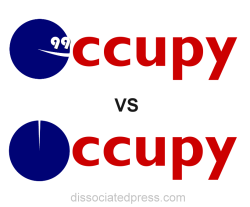 I’ve personally begun A-B testing for the revolution. |
If you’ve visited DissociatedPress.com with any regularity over the last few years, you know that I’ve been a bit annoyed with Wall Street since 2008 , when the industry built on gambling your hard earned dollars on sophisticated ponzy schemes to line billionaire bankers’ pockets with bonuses came tumbling down like a lost weekend in Vegas. Except when the hustlers lost their wad and woke up with a brain splitting hangover, they somehow managed to convince everyone to float them JUST ONE MORE TIME, swearing they’d mend their evil ways. Well, like any addict struggling with an addiction, they lied of course, slipped themselves a bunch more bonuses and wild parties just months later, and in the big picture, pretty much broke capitalism in the process. So it was with some excitement that I started watching the Occupy Wall St movement begin to gather steam last month; I even set up a site at OccupyAnnArbor.org, figuring if the movement didn’t arrive in my town on its own, I would HELP it arrive. No worries there though, within a few days of creating the site, about 1200 people had gathered spontaneously on one of the many Facebook groups that had suddenly popped up. Which is what I think the power of this movement is; it is genuinely grass roots and citizen-driven. People make fun of the cardboard signs being used at most gatherings, but to me those signs are a GOOD thing. As soon as we start seeing a lot of professionally-produced signs, we can probably assume the movement has been co-opted by a particular party or interest group. But that doesn’t mean we have to prove the “none of us is stupid as all of us” adage is actually TRUE. I think all the ninety-niners (see what I’m doing there?) should take a moment to read Frank Luntz’s Words That Work, and maybe Lovemarks, the brilliant book by Kevin Roberts about why we love the brands we love. The reason to read that first book is because Luntz helped the GOP understand the winning strategy of “it’s not what you say, it’s what people hear”, and the reason to read the second one is because it might help protesters understand that as much as using a black power fist makes you feel like you’re partying with Jimi Hendrix and Malcolm X, it makes the casual viewer think you’re a naive socialist who is out to undermine the American way of life. So while lots of artists like Shepard Fairey and Rob Sheridan are offering up free designs, I think even these talented designers are going a little too “oppressed laborer” with the imagery. So I’ve assembled a few images and ideas of my own about how to reframe the revolution a little. Feel free to chime in or share some interesting thoughts of your own, and if you’re looking for some inspiration, there’s a healthy collection of motifs here. Read the rest of this entry »