Technology
« Older Entries |
Newer Entries »
[ 1 Comment ]Posted on February 4, 2011 by admin in Technology
Friday, February 4th, 2011
The iPhone finally comes to Verizon, but will it sound better? Time will tell, but have you ever wondered WHY the audio quality of cell phones is worse today than landlines were thirty years ago?
 
The only app I want on an iPhone is
the one that makes it actually
function for voice communication |
A friend asked me today if – since I’m a Verizon customer – I was FINALLY going to get an iPhone. Referencing “Convoy”, the 70′s novelty radio hit and movie
 about truck driver CB radio culture (here’s the trailer), I replied “that’s a big fat negatori, Rubber Ducky“. Yes, I’ve said it before. When it comes to technology, I’m a big whiny baby. Just see my Disappointing Technologies Part I and Part II. Or my explanations of why your mp3′s or your robots suck. But one thing I probably have found more annoying than anything – whether technology related or not – is the infernally faulty and obscenely expensive set of devices and services that we end up calling a “mobile phone”. Aside from the absurd prevalence of dropped calls (a friend of mine has a four square foot area in his Chicago apartment where his AT&T iPhone works that we call his “iZone”) I’ve always been astounded that in the 21st century, a device that is specifically designed to transmit your voice to another person’s ear does it less effectively than the walkie-talkies I played with as a kid. And this horrible sound quality is nowhere more obvious, in my opinion, than with an iPhone. This Wired piece explains that part of this problem will go away with an iPhone on Verizon’s networks, but I predict that the fundamental audio quality of cell phones – which is arguably a joke compared to landlines of even thirty years ago – will not get any better soon. Why? The first reason is that – as most of us would agree these days – a cell phone isn’t for talking, it’s for texting, web browsing, and apps. Verizon is well aware of this, and started revising all their data plans in preparation for the launch of the Verizon-compatible iPhone, which will add a new kind of load to their networks. And the second reason? It’s the fact that no-one seems to care about the atrocious audio quality of modern cellular/wireless networks. If it ain’t broke, why would they fix it? If you don’t know what I mean, you’re either a digital native who wouldn’t understand the old pin drop commercial of a couple decades ago, a very tolerant person, or perhaps just plain deaf. Remember when you were a teen, and in naively romantic moments in the wee hours on the phone, you’d play your boyfriend or girlfriend some cheesy song that expressed your complex teen feelings in a way that words never could? Well, forget it pal. If you have typical cell service in America and have ever tried to achieve anything beyond the garbled, delay-ridden talking that we’re used to, you know what I mean. But have you ever wondered why? You’d think it’s because the signal is being bounced through the atmosphere to a bunch of towers, maybe a satellite, and then a few more towers, right? Well, that is in fact part of the problem. But the real problem has two more elements. One of them is profit. Rather than investing in and building out high-quality capacity and then charging you for it, providers will continue to offer you the lowest acceptable quality to eek the most out of existing networks. And if customers don’t seem to care about the audio, they’ll continue to focus on non-voice data transfer. The other part of the problem is the audio compression codecs providers use to squish decipherable voice information into the smallest possible amount of data. Somehow, the rather shoddy codecs used for the 128kbps mp3′s you buy on iTunes became accepted as the industry standard for quality audio. That’s probably okay ultimately; studies show that the majority of people actually can’t distinguish that bitrate from higher quality sound sources. So fine. Let’s just say that’s acceptable audio. But if you’ve ever heard a song in say, a 64 or 32kbps bitrate, you know how bad things start sounding pretty quickly. And although simple voice data may even sound clearer around 32kbps (because a lot of people’s weird breath and mouth noises get compressed out) you may be surprised to know the actual compression and frequency response numbers for standard cell phone service. The bitrate is often 8kbps, and the frequency range being used is typically 400 Hz to 3500 Hz. For comparison, a decent stereo system has perhaps 60 Hz – 18,000 Hz capability. The 400 Hz – 3500 Hz part wouldn’t be so bad by itself, because aside from harmonics that affect the timbre and the sibilant sounds we make, the majority of vocal sounds are in that frequency range. The real problem is in all the other things the audio codecs do to compress the voice data. While it is in fact INCREDIBLE what audio engineers and programmers have developed over the years to facilitate various kinds of voice audio compression, the choice to continue applying the most “aggressive” of these algorithms and codecs is what makes your cell call sound like crap. Aside from the low bitrate and limited frequency response, the voice signal is further analyzed and hacked up with things like voice activity detection and linear predictive coding, which decide whether something is a voice, background noise, or silence. The codec then discards whatever it thinks is not useful voice information, further compresses the data, transmits it, and reverses the process on the other end. Thus the word “codec”, which is a portmanteau of “compressor-decompressor”. The result of all this secret-decoder-ring monkeying around? Well, when you combine it with the bizarrely un-ergonomic deck-of-cards-like shape of an iPhone and the tiny mic and specialized audio processing designed to compensate for it, the result is that horrifying shriek that interrupts your friend’s garbled voice when their child says something at a normal volume in the background. So no, I won’t be rushing to the Verizon store to pick up an iPhone. In fact, I’m thinking of switching to one of these little handheld CB jobbies
 . It says the range is only four miles, but that’s without shootin’ skip.
Read the rest of this entry »
[ 1 Comment ]Posted on January 28, 2011 by admin in Technology
Friday, January 28th, 2011
The simple answer is “yes”, but Egypt’s unprecedented nationwide shutdown of internet access highlights a plethora of issues beyond whether or not Egyptians could watch Keyboard Cat videos on YouTube.
Imagine you woke up one morning and went to check your e-mail, and the internet was down. “Damn”, you think to yourself, “oh well, I’ll check it on my mobile phone and figure out the connection problem later”. Then you find your cell phone won’t get a connection. For many of us, we’d wonder if the world were ending. If you’ve ever left your phone somewhere in the middle of a busy day, you may know that panicked feeling, which you may or may not get over quickly, depending on your communication needs and personal psychology. Well, as you probably know by now, the entire country of Egypt woke up to that problem yesterday. No internet. No phone service. Especially as an outsider, you may think “Big deal. I never call Egypt or browse Egyptian websites anyway”. But it may not have occurred to you that even the US Embassy website was not available. Although it is now, presumably because according to this Netcraft query, they switched ISP’s today. And then of course, there’s commerce. If you know anything at all about modern business, you know that even convenience stores rely on internet connections, to process credit card purchases. Which would probably explain why the only Egyptian ISP that was still operating was NOOR Group, which not only hosts the Egyptian Stock Exchange, but also has some heavyweight global corporate clients. So how was Egyptian President Hosni Mubarak able to just “flick a switch” and shut off all these services? This MSNBC piece explains in plain English that in the case of Egypt, the government owns the ISP’s that provide all the networks that make the internet the internet. So he simply had to issue an order to shut things down. Whether they did it physically, by shutting down equipment, or digitally, by instructing the systems to process traffic differently, is largely irrelevant. They effectively shut down the internet and cellular communications in the country, forcing protesters to use what we might call the “Islamic Sneakernet”. Good old-fashioned person-to-person communication, fairly effectively transmitted via mosques, as this Wired piece suggests. So could the US government do the same thing in times of civil unrest? You bet. And frankly that kind of possibility is why – although I often get flak from friends about it – I KNOW I’m not crazy for constantly ranting about the evils of agency capture and the telecoms in America. Although there was a lot of hubbub last year about Obama being handed an “internet kill switch” with the “cybersecurity act”, this was simply not true. It was flat out, unquestionably bald-face lies, wrapped in the language of the moronic political blogosphere, which even infected tech blogs like the one just linked to. But it hardly matters if Obama were handed an “internet kill switch”; he already had one, as every president has since before the internet even existed, in the form of Title VII of the Communications Act of 1934. The internet needs the telecoms, and in national emergencies, the government controls the telecoms. And it’s worthy of note that even though we don’t specifically have an internet kill switch now, people politicians like Joe Lieberman want one bad. But regardless of all these hypothetical issues, shutting down the internet in reaction to the mass unrest in Egypt has highlighted a plethora of other issues. Economically, it could be catastrophic. US markets already took a plunge Friday, and worse repercussions may be expected on Monday. The events have also highlighted the US government’s awkward stance toward Egypt; they can hardly come down hard diplomatically, when they give Egypt billions in support annually and use Egypt as a favorite location to make prisoners disappear during an extraordinary rendition. And perhaps most importantly, given the American media’s shallow coverage of what’s happening in Egypt, the internet would have been a great way to get more meaningful coverage. By the way, as that article points out, you still can get some better coverage from Al Jazeera. And finally, the fact that a country can shut down its internet like this may provide a huge boost to the satellite internet business. Because although there are other ways to skirt an internet blackout, they require a rather high nerd quotient, as the PC World piece Get Internet Access When Your Government Shuts It Down makes abundantly evident.
[ 1 Comment ]Posted on January 20, 2011 by admin in Technology
Thursday, January 20th, 2011
Professor Akira Iritani may very well succeed at cloning a Woolly Mammoth. Hasn’t this dude seen Jurassic Park or Godzilla?

Delphine Chanéac as a toddler |
Could someone please send Professor Akira Iritani – the guy who’s all excited about cloning a Woolly Mammoth – a copy of The Lost World – Jurassic Park , a copy of The Godzilla Collection on DVD
 , and a link to this old news article about ivory consumption in Japan? I mean, as a person who suffers from a terminal case of tech ennui, I’m all for cloning. Especially if I can clone, say, Isabella Rossellini or Delphine Chanéac. Oh. Never mind. Someone already cloned Delphine, and that didn’t turn out so well
 , did it. Which is sort of the point I want to make here. Although cloning has phenomenal potential to benefit the human race, the practical and ethical ramifications are so poorly understood at this juncture that it seems almost comically irrational to tackle cloning a massive mammal that’s been extinct for 10,000 years. Especially when, so far, the greatest success with cloning has been a sheep named after a big-breasted country music star, and the closest thing we have to a Woolly Mammoth that’s still living is in danger of extinction. Sure. Gimme one o’ them elephants, I got me some Woolly Mammoths to make. Please Dr. Iritani. Baby steps. BABY steps.
[ Comments Off ]Posted on January 12, 2011 by admin in Technology
Wednesday, January 12th, 2011
For about a hundred grand, you can train for combat or engage in misanthropic virtual reality gaming in the Virtusphere “human hamster ball”. Or, you could go analog and Zorb in a Mega Ball for just a few hundred bucks.
 If the time you spend Facebooking, watching Keyboard Cat on YouTube, and buying real estate on Second Life haven’t satisfied your need to completely isolate yourself from humanity, fear not – technological innovation will continually bring you new methods to embrace your inner misanthrope. The Virtusphere isn’t all that “new” in tech industry terms; it was first broadly featured in 2009 (see a Reuters video here), and received more exposure at last years’ tech shows. But somehow, it hasn’t grabbed as much press as one might expect. We suspect this is a result of an elaborate stealth marketing campaign the company has put together, using Zhu Zhu Pets
 to slowly acclimate the human population to the idea that playing all your favorite first-person shooter games will be much more fun if you’re wearing VR headgear and running around inside a giant hamster cage. Actually, although gaming and virtual tours are part of the company’s pitch for the product, as of this writing a visit to their web site makes it clear they’re probably more interested in the much more lucrative cash cow of recklessly padded US Defense contracts. Frankly, we find killing and war to be rather ass-backwards, Cro-magnon uses of emerging technologies, so we have a suggestion for this market segment. If you want to put soldiers in giant hamster balls so they can learn how to kill more effectively, why not just put REAL soldiers in the balls with live ammo and take cagefighting to the next level? You’ll create much more ruthless killing machines, while saving a crapload of money on the IT and programming budgets to develop all those glitchy combat scenes that look like they were created for a 1990′s arcade game. If you want to go with the recommended fully electronic version, visit their marketing site. Although they don’t mention pricing upfront, this review suggests the tab will be something like $50,000-$100,000 to (ahem) get rolling. Of course, if you have a smaller budget and don’t mind going analog, you could always get into Zorbing. A Mega Ball is only 379 bucks
 on Amazon. Vids below. Read the rest of this entry »
[ Comments Off ]Posted on January 5, 2011 by admin in Technology
Wednesday, January 5th, 2011
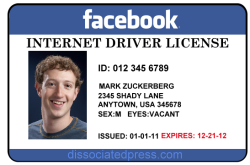
In addition to the blood of your firstborn, a retinal scan, and other biometric methods. Do you trust Facebook to be the issuer of your “Internet Driver’s License”?
 Sometimes I feel like I’m Charlton Heston’s character in Soylent Green
 , running around screaming “it’s made of people!” while the masses around me munch away muttering through full mouths “but it’s so yummy“. Recently I asked the opinion of friends on Facebook about which e-mail client I might switch to after having a nightmarish experience “upgrading” to Thunderbird 3 (an experience that many have shared, by the way). One thing that surprised me a little was that a few tech-savvy friends said “why not G-Mail?” to which I replied “because it’s a web service not an e-mail client” and added “besides, I don’t like all my messages eternally remaining in the hands of a company whose CEO has so much contempt for personal privacy“, to which one of these friends said “privacy is an illusion”. Which let me use one of my favorite ironic quotes, i.e., Obama’s Cynicism Is A Sorry Kind Of Wisdom. Because while it’s true that certain lifestyle choices insure that most of your life is an open book, that doesn’t mean we all have to roll over, shave our heads, get our citizen ID tattoo, and start living like we’re in the movie THX 1138
 or something. Call me a Luddite, but in spite of the fact that I have nothing to hide, I’m not going to give all my trust to Google and Facebook when it comes to my personal communications, and I’m certainly not going to start “checking in” with services like Foursquare or Facebook Places. I feel like there are degrees of privacy, and that we’re all entitled to maintain as much as we like or are able. I was a little annoyed that Google captured me sitting on my porch a few years ago, but I’ve since moved, and clearly, I blew my own cover in that instance out of amusement. But how would you feel about Facebook being your Internet Driver’s License? That idea doesn’t appeal to me too much, for a few reasons. First, on top of the fact that Mark Zuckerberg has already declared privacy dead, ex-Googler and Facebook COO Sheryl Sandberg agrees, and is probably more eager to sell your data than Zuckerberg is. And since that’s a Gawker Media article I just linked to, let’s just take a moment to remember what can happen to millions of us at once when we entrust our personal information to a site that thrives on verified users but doesn’t care about their privacy. Facebook has done little to improve the security of your information as they’ve grown; anyone can still easily download this Firefox plugin and start hacking nearby users’ accounts with a method called sidejacking, and Facebook’s one time password solution for mobile users has a profound intrinsic flaw that I’m surprised hasn’t gotten more attention. My recent favorite was when I went to log in and Facebook put on a little Security Theater (see nice overview of the process here if you haven’t experinced it yet ) for me by asking for another e-mail, my mobile number, and then asked me to identify my friends in a lineup. Something that apparently has created real problems when people have been asked to identify friend’s dogs and Gummy Bears to get into their account. Becoming the sole single sign-on service provider so far remains the holy grail of huge tech companies like Google and Microsoft, but now it looks like Facebook has a chance of pulling it off. How would you feel about Facebook being the primary issuer of your internet traveling papers?

