Popular Media
« Older Entries |
Newer Entries »
[ Comments Off ]Posted on March 30, 2011 by admin in Popular Media
Wednesday, March 30th, 2011
A look at the “Hilton in space” aesthetic, how Star Trek DIDN’T predict the iPad, and a preview of how Star Trek perpetuates race and gender exploitation with hot green chicks and bullet bras.

Spock laments the state of Desktop
computing in the 23rd century. |
I’ve confessed this before, but here it goes again. I’m secretly a bit of a Star Trek fan. However, there’s a good reason for this that I don’t always share, which is the little-known fact that at one time I was actually captain of a starship. Only, of course, if I was the first one to the jungle jim, or otherwise engineered the demotion of one of my fellow officers during recess in second grade, but a starship captain all the same. These days, as an aspiring adult, I occasionally still get a kick out of watching episodes from various Star Trek franchises, but mostly as a sort of historical review of production and story trends over the years. For me, the original series is the most resilient, primarily because – in part due to budget constraints but in part due to Gene Roddenberry’s unique vision – it was more like theatre than television. The fact that a man with funny eyebrows, sinister facial hair, and a dark complexion was an evil alien, or that a bank of blinking lights with no discernible function was a supercomputer, were perfect production elements, and perfect environments for the overwrought, scenery-chomping acting that delivered the usually high-concept stories that Roddenberry and his writers created. This simplicity of props and sets served the series well, especially when it came to devices. The fewer the details demonstrated the better, because then one would just accept that the device did what it did, without breaking the suspension of disbelief with critical analysis. A perfect example of this is the PADD devices, the various handheld gizmos used by characters over the years. In the original series, it was just a mysterious tablet-like device with a few blinking lights. No attempt was made to show what it really did, or what its display looked like. This was smart, because it’s a safe bet that they would have made it look like an Etch A Sketch
 . Which is where I think a lot of the later franchises began to fail in little ways. Characters with big rubbery heads just make you wonder what their big rubbery heads are made of, and props, sets, ansd costumes with decade-specific designs just make the show look like it’s from a specific decade. Which is something I’m going to explore over the course of a few articles, because one side effect of re-watching these old shows on today’s digital devices for me is that I obsessively create screen grabs of things that jump out at me, to document the thoughts I’m having. I’m going to start with my low-level irritation with the tendency for tech writers and sci-fi fans to suggest that the Star Trek franchise somehow “predicted” the iPad (that’s otherwise a really interesting article by the way). While I have tremendous admiration for the concept and design work of Michael Okuda, who, among other things, developed the look of the user interfaces (which fans call Okudagrams)seen in the later series, I recently learned that the main original designer – Matt Jefferies – shared my mild contempt for the PADD devices and later “updated” set designs. I’ve always had a hard time accepting that 300 years from now, we’ll still be carrying around little PDA’s when technology is otherwise so sufficiently developed as to enable us to bend space and disassemble and reassemble objects on an atomic level. It’s said that Jefferies didn’t approve of the inclusion of the original series’ “captain’s tablet”, fell asleep while watching the first movie, and referred to the later bridge design as a Hilton in space. Below are some screen grabs that demonstrate how – at least in my opinion – all the PADDs and other handheld devices predicted nothing, and in fact very much reflected the design aesthetic of the decade of the show in which they were utilized. I’ve also included a few screen grabs to preview some upcoming pieces that will touch on fashion, sexism, and general design. Read the rest of this entry »
[ 2 Comments ]Posted on March 25, 2011 by admin in Popular Media
Friday, March 25th, 2011
Does that mean it’s not a zombie film? I’m not going to let that trouble me. The thing that disturbs me most is that the virus in the film seems to be spreading to the real wor the real the wor the real wor real world.
  |
I really don’t like zombie movies. Well, okay. I liked Night of the Living Dead when I was a kid. And Shaun of the Dead
 was fun. But in general, the basic idea behind a zombie movie – a mindless mob chomping on something that’s probably not healthy for them – is too much like just living in America – which I already do – for me to get excited about. Which is why it’s odd that I LOVED Pontypool, because it’s a zombie movie. Or is it? While the story does involve mindless mobs chomping on each other, they’re mostly offscreen. There is a bit of gore, but I wouldn’t actually call it gratuitous; it was pretty purposeful from a dramatic point of view. And the entire story pretty much takes place in the confines of a radio station, while the world outside is going mad. No, Pontypool is more a suspense film with cultural-linguistic and socio-political commentary. Sort of like Talk Radio
 meets the original War of the Worlds radio broadcast
  . But better. The film makes clever use of Antonin Artaud’s idea of theater as infection, and Burroughs’ concept of language as a virus. And the commentary I mentioned is used sparingly; this is really a pretty solid “low budget” suspense film, with a balanced dose of humor and a little mystery to engage you. Is it an alien zombie apocalypse? A biological warfare experiment gone wrong? Is the strange behavior of the unseen mobs being caused by something in the radio transmission? What if simply speaking transmitted a disease? How could you tell anyone? Except for that last question, these are familiar enough story premises, so Pontypool doesn’t kill them with exposition, instead letting them answer themselves as the story unfolds. But imagine if words broadcast over radio or television had the ability to spread a bizarre condition that in turn affected your speech to help transmit the condition further? That would be a prah. A prah. A prah. A prah. Oh crap. A prah. A PROBLEM. Actually, one of the most disturbing things about this clever little zombie suspense film is that it seems to be manifesting in the real world. See the two news clips below, after the trailer. Oh, and Pontypool was adapted from the book Pontypool Changes Everything
 and is also available as a BBC radio play.
Read the rest of this entry »
[ Comments Off ]Posted on March 22, 2011 by admin in Popular Media
Tuesday, March 22nd, 2011
…would be staying at this couple’s apartment.
 Or is there something else going on here? A friend sent me a link to the video below today; it’s supposedly a re-enactment of Assange’s stay at the home of friends of established comedy writer Allison Silverman. As I watched the video distractedly while I worked on something else, I thought to myself “Yeah, yeah. Pretty much what you’d expect from some narcissistic, self-aggrandizing, internationally known hacktivist type“. I expected to find at least a little humor in the thing, but didn’t. In fact, as I continued to watch, I found myself thinking “Damn, these pretentious urban hipster assholes are even worse than Assange!” I mean, by creating an elaborate video featuring their friends Michael Brumm and Peter Gwinn (Colbert writers) and David Rees (creator of Get Your War On
 ) to publicly air their petty complaint about their slovenly houseguest, weren’t they themselves showing even less class and more ignorance of “real” social grace? In the end, I’m not so sure. If you haven’t seen the video, please watch it before you read the rest of what I have to say, below.
Read the rest of this entry »
[ Comments Off ]Posted on March 14, 2011 by admin in Popular Media
Monday, March 14th, 2011
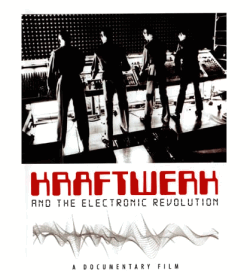
If you have three hours to kill and love German electronic music, this Kraut Rock doc will knock your socks off. And if you just don’t have the attention span, you can always pick up Kraftwerk’s new “Kling Klang Machine” iPhone app.
If you don’t have the attention span for
the documentary, maybe you should just
get the unrelated Kling Klang iPhone app. |
If by chance you spent any time in a nightclub in the last thirty years, there’s a fairly good chance that you owe what your feet were doing either directly or indirectly to the band Kraftwerk. From their early experimental work that led to the more commercial Autobahn and Radio-Activity
 in the mid 70′s, right through their infectious and often re-mixed machine pop of the 80′s, Kraftwerk’s music helped shape the entire Punk/alternative waves of the 70′s and 80′s. In part by helping inspire Bowie and Eno to move to Berlin, and in part by creating the basic template for the sounds of tunes like Donna Summer’s “I Feel Love”
 and bands and artists like Gary Numan
 , Depeche Mode, Orchestral Manoeuvres in the Dark, and Human League, to name just a few. And it’s probably safe to say that entire genres – like techno, industrial, and house – would not later even exist if it weren’t for Kraftwerk’s innovations in electronic pop and dance music. Hell, without Kraftwerk, Sprockets itself would be impossible. And then whose monkey would we touch? I’m stating the obvious here, mostly for any ignorant young hipsters reading that haven’t pieced these facts together yet. My own experience with Kraftwerk began as a teen, being transported to alternate realities by the sonic landscapes of tunes like “Autobahn” (with perhaps a little neurochemical assistance), which inspired me to become a fairly obsessive synthesist myself in an era before electronic pop really even existed. It’s important to note that while artists like Wendy Carlos were creating their brilliantly elaborate, but still bleepy and sqawky works like Switched-On Bach
 , Kraftwerk was creating electronic pop music so listenable and evolved in its sensibilities that artists like Eno have described it as “nostalgia from the future”. And Kraftwerk’s brilliantly simple marketing themes – from the slyly uber-teutonic Autobahn album cover with its iconic Mercedes Benz and Volkswagen cruising through the rolling hills of a Germanic dreamland, to their later images that implied – but directly never mentioned – the coldly intellectual clean cut scientists of World War II Germany – have helped maintain a peculiar mystique around the band for decades. I mean, have you ever actually seen or heard zee operator wiss zee pocket calc-u-lator speak in an interview? Probably not, unless you stopped by KlingKlang Studio in Dusseldorf and caught them in. The studio doesn’t even have a phone, according to this Guardian piece that explores the band’s press stealth, but manages to illicit “I got a new head, and I’m fine“. But enough of my sycophantic drivel, I really just wanted to suggest that if you have three hours and an obsessive interest in the intricate details of Kraftwerk’s evolution, you should check out Kraftwerk and the Electronic Revolution. It explores the entire German electronic music scene from the 60′s through to the 80′s, with Kraftwerk as a main course but with fairly hearty (and probably necessary) side-dishes of Popol Vuh, Tangerine Dream, Amon Duul and Neu! If you’re REALLY into Kraftwerk, you may have already seen it; it’s been out since 2008. I personally only discovered it the other day. I recommend watching it as a mini-series though; three straight hours of in-depth commentary and analysis was a bit much even for a lifelong fan like like myself. It’s already a great deal as an on-demand DVD, but there’s also a $2.99 download
 . And if you simply don’t have the attention span, maybe you should just get their new iPhone app, released last week.
Read the rest of this entry »
[ Comments Off ]Posted on March 7, 2011 by admin in Popular Media
Monday, March 7th, 2011
Our coverage of the world’s largest short film festival is two weeks late and a film short.
 It’s a testament to my short attention span that I didn’t mention this year’s Tropfest short film festival winner a few weeks ago. This was especially shortsighted, given the combination of my obsession with short film and the fact that I ranted about Australia’s Blue Tongue Film shorts just three days before Tropfest announced this year’s winner, Animal Beatbox (also below). Ah well, “a week late and a film short”, as they say. If you haven’t heard of Australia’s Tropfest, don’t feel badly. In spite of laying claim to being the world’s largest short film festival, it seems to get remarkably little press in the states. Tropfest was created nineteen years ago by John Polson as an informal short film screening for cast, crew and friends at the Tropicana Cafe in Sydney. 200 people showed up the first year, and it’s been growing ever since. Past celebrity judges include names like John Woo, Samuel L Jackson, Baz Luhrmann, Keanu Reeves, Ewan McGregor, and Jane Campion, and as of this year, the festival attracts a live national audience of more than 150,000 people on a single night. One little thing that makes Tropfest unique and helps keep the films fresh is that there’s Tropfest Signature Item each year, an item that must be referenced in the film somehow. This year’s TSI was “Key” which explains why the festival graphic here is a pile of silhouetted keys. Below are two of my favorite winners of the last few years – Marry Me from 2008, and Be My Brother from 2009 – followed by this year’s winner, mentioned above. I have to say, I love that one of the promotional pieces (also below) dredged up the old Hitchcock quote “The length of a film should be directly related to the endurance of the human bladder“. See more winners and 2011 finalists on Tropfest’s YouTube Channel.
Read the rest of this entry »
