
Politics
« Older Entries | Newer Entries »Broadband Providers Fear Getting FCC’d Over By Obama Plan
[ 1 Comment ]Posted on March 26, 2010 by admin in Politics
Friday, March 26th, 2010It’s a shame that one in three Americans wouldn’t understand half of the FCC report their Internet connection is too slow to download.
 My favorite new way to start a sentence is “well, now that we got that health care problem licked, we can…” because you can say almost anything after that, and no-one will hear a word of that you say. Which I fear will end up being the problem with the political topic du jour of the last few days, i.e. The National Broadband Plan. While Americans are still seeing little birdies and stars circling their heads after going a bunch of rounds with the health care fight, the administration is following up with the rollout of the massive plan to give everyone in America broadband . One interesting thing about the plan is that according to the report itself, it would take 6% of Americans 27 minutes to download the 11.5MB PDF file. Yes, not only are 35% of Americans still without broadband, but almost 1 in 5 of those are on dial-up! Strangely, in spite of all the billions being raked in by American service providers like Comcast, Verizon, and AT&T, the US ranks 15th globally in both broadband speed and availability. Although part of me cynically thinks that making sure that this disenfranchised 35% has broadband just means we’ll see more talking smiley banner ads, more porn consumption, more security exploits, and heavier YouTube server loads, the more hopeful and human part of me knows that the impact on education, innovation, and commerce could only be positive. And my faith in the core of the plan is reinforced when I read articles like this Information Week piece that suggest that America’s feeble broadband standing – so far driven by monopolistic private enterprise – is good enough. And by the fact that the that the only parties questioning the plans so far are politicians who suggest that the government running ANYTHING is bad . I mean, am I the only one who finds irony in the fact that a person whose job it is to run the country suggests that the government doesn’t know how to run anything? It’ll be interesting to see what kind of partisan spin the new broadband plan receives over the next few weeks. Some think the Hatorade will flow freely. What do you think about the new broadband initiatives? Read the rest of this entry »
The Tea Party? The Coffee Party? Wake Up. It’s The Corporate Party
[ 1 Comment ]Posted on March 21, 2010 by admin in Politics
Sunday, March 21st, 2010The real power in this country lies in the hands of corporate interests in ways most people don’t understand.
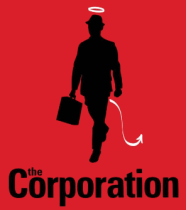 For some unsettling insights into who’s really running things, check out the DVD  or the book or the book “The Corporation”. “The Corporation”. |
When it comes to politics, I sometimes get the feeling lately that I’m having one of those weird anxiety dreams where all the surroundings are basically familiar, but everything is just a little different somehow, and everyone else knows what’s going on except me. When you have a bunch of mostly working-class people calling themselves “teabaggers” marching against the party that historically has been on their side calling legislators niggers and faggots, and the best response that the liberal intellectuals of the country can muster is a contrarily-named coffee party, you have to pause and ask: what really is going on here? Well, after doing more reading and research on the topic than I’d really care to, I have a bit of an opinion forming. Almost every problem that I see in America right now can be traced to one basic source. Corporatocracy. Whether it’s the corruption that ensues from regulatory capture by way of DC’s revolving doors, or the travesty that is the current health care battle, or the incredibly unsustainable and unhealthy diet and food production process in America, it can all be directly traced to corporate interests. I’ve longed for a third party for some time now, and was too dense to realize it was right here all along. It’s big business. Whether it’s campaign donations, lobby dollars, or the direct infiltration of the government via the aforementioned “agency capture”, Global and national corporations are clearly more powerful than government today. And the sick part of the big joke is that the GOP will probably deflect attention from their profoundly corporatocratic beliefs by using the widely misunderstood term corporatist to call Democrats fascist corporatists (which will be partly true, in an odd way) and both groups of voters will buy into their side’s spin. The irony of course being that both parties will be telling some twisted version of the truth, while benefiting personally as people of wealth and power by keeping the citizenry split down the middle, pointlessly hoping for a democracy-based solution.
Coffee Party Movement Grinds To Halt In Soy vs Lowfat Debate
[ Comments Off ]Posted on March 15, 2010 by admin in Politics
Monday, March 15th, 2010When I wrote about Why Democrats Always Lose & Why American Voters Need A Brand a while back, I was hoping for something a little more inspired than a choice loosely based on the title of a now painfully politically incorrect “tell all” book from the “swingin’ sixties”. Yes, the American liberal has once again [...]
  |
When I wrote about Why Democrats Always Lose & Why American Voters Need A Brand a while back, I was hoping for something a little more inspired than a choice loosely based on the title of a now painfully politically incorrect “tell all” book from the “swingin’ sixties”
Washington’s Revolving Doors Make My Head Spin
[ 3 Comments ]Posted on March 9, 2010 by admin in Politics
Tuesday, March 9th, 2010The corporate takeover of the US Government is not tin-foil hat stuff, it’s well documented. We just don’t pay any attention. But will we ever DO anything about it?
 This attractive revolving door is made by the Crane Door company. We didn’t research them for influence peddling. |
I like to think of myself as a little more informed than the “average” citizen – whoever they are – yet I regularly find myself to be disturbingly naive (okay, just plain stupid) regarding how things really work in our government. It has bothered me for some time that our government seems to have been taken over by the finance industry, and that it operates in creepy collusion with a telecom monopoly, but until taking a closer look recently, I had no idea how active that revolving door in Washington really was. Considered “business as usual” by most Washington insiders, it even has a polite euphemism. Instead of calling it a corporate coup of our government, it’s called Agency Capture or Regulatory Capture. I believe in the old school Republican idea that government can be bad for business, but I can hardly accept the reverse, i.e.: that business is good for government. I think the recent banking catastrophes and USDA food safety failures speak for themselves; with the former you have the revolving banking industry/treasury department door, with the latter, the USDA/Monsanto door. I would be astounded if the current administration’s plans to make changes in revolving door policies were successful; the practice is simply far too pervasive. The amount of information on government agencies that are staffed with former corporate influence peddlers is overwhelming. Eisenhower warned of us the Military Industrial Complex back in 1961, and Monsanto has been a target of this scrutiny for some time; see lists like this one or this one. But these are just high-profile, extremely well-funded examples. This form of governing reaches across every industry, and at all levels of government. I’ve compiled a table of examples below, but for a really amazing resource, check out Open Secrets’ Revolving Door database. You can use it to do things like starting with a list of over 300 former public servants to track their connections, or look at revolving door employees by agency. The White House has nearly 500 on staff itself. In spite of the overwhelming number of federal employees that are infecting the way our government runs, there is a bright side. Rather than feeling paranoid and powerless against cold, inhuman, and faceless corporations, we COULD start targeting the actual people responsible with civic action. They only get away with it because we don’t pay attention. The tables and images below begin to give it all a face. Read the rest of this entry »
False Profits Of The Econopocalypse
[ Comments Off ]Posted on March 4, 2010 by admin in Politics
Thursday, March 4th, 2010We’re in the midst of a great opportunity to create real change, and we’re blowing it, because bankers are smarter than we are.
 Maybe these banker guys just have better connections than the rest of us do |
I’ve often said that two of the best jobs in the world to have are Economist or Weatherman. Who else gets paid so much to be wrong so often? I was reminded of this recently while reading Busted: Dean Baker On The Price We’re Still Paying For The Housing Bubble in The Sun Magazine. Granted, The Sun is about is hippy-dippy liberal as publications get, but Baker says some insightful things in the piece, key amongst them being that “Economists think they’re doing their job if they are saying the same thing everyone else is saying“. He points out that economists tend to say what their bosses want to hear, for risk of damaging their careers; a couple of classic examples of this being of course demi-god Alan Greenspan, who finally fessed up about how wrong he was, and Ben Bernanke, who’s been saying there’s no bubble since 2005. Guess who still has the sweet job? Bernanke just began his second term as Chairman of the Federal Reserve on February 1. What boggles my mind at this point is that now that we KNOW top-level government and banking experts were so wrong, why do they still have jobs? If you were to make a series of decisions that bankrupted the company you work for, what would you expect to happen? The answer is obvious, so why do we – as a people – tolerate the ongoing abuse of the very banks we bailed out? Why didn’t the taxpayers get profit sharing and bonuses for bailing out the banks, instead of the CEO’s that caused the mess? I’ve been whining about the bailouts since day one, and have remained astounded at how little coverage the Quiet Coup has gotten. That Atlantic article just linked to explores what’s really happening in America right now, pointing out that “…the finance industry has effectively captured our government…” and that “…recovery will fail unless we break the financial oligarchy that is blocking essential reform…”. Which is why I’m glad some doomsayers are still saying that we’re Running On Empty or asking if maybe the government is Hiding How it Bailed Out AIG and Goldman. And finally congress at least seems to be looking at it this all as a problem. If you haven’t quite come to understand or accept the fact that your government has been “hijacked by the oligarchs” read this lengthy but level-headed Bill Moyers interview with Simon Johnson. You might start thinking that healthcare is the least of your worries.