
Clean & Green
« Older Entries | Newer Entries »Let Me Tell You ’bout The Bats And The Bees
[ Comments Off ]Posted on September 6, 2010 by admin in Clean & Green
Monday, September 6th, 2010Because this is one environmental topic that should bee generating more buzz.
 Yes, bats pollinate too. Source |
You may have heard about the massive die-off of bees caused by Colony Collapse Disorder, or the possible extinction of a number of species of bats caused by White Nose Syndrome. But have you thought about the ramifications or kept up to date on the causes? Depending on the source, the cost to agribusiness resulting from continued bee die-offs ranges from $14 billion to $92 billion annually. And if the bats continued dying? Some species of bats can eat as many as 3,000 insects nightly, mosquitoes being common prey. To frame that more dramatically: the colony of approximately 20 million free-tailed bats at Bracken Cave, Texas, eats up to a quarter-million pounds of insects in a single night. Or put another way, the weight of 462,962 6oz cans of Deep Woods Off
Wheeling & Dealing In Michigan – A Hemp Based Auto Industry?
[ 2 Comments ]Posted on September 1, 2010 by admin in Clean & Green
Wednesday, September 1st, 2010Could legalized hemp solve Michigan’s economic woes? Even if it didn’t, the recreational use would sure take the edge off Michiganders’ trademark up-tightness.
 I think the solution for Michigan’s economic woes is sitting right under our noses. Or perhaps in someone’s bong. You may have heard recently about the Kestrel, a new electric car with a biocomposite body being engineered by Motive Industries of Canada. What do they mean by biocomposite? Hemp. You may already know that hemp is a versatile material for manufacturing, but you may not be aware of hemp’s connection with the very origins of the auto industry. It seems that Henry Ford not only originally envisioned a world full of automobiles fueled by ethanol (with hemp as one of the primary sources of biomass) but even built a hemp composite car all the way back in the 1930′s . So weed and wheels have a long history. Given Michigan’s recent foray into legalizing medical marijuana, maybe the state should just go all the way and make a commitment to cannabis as an industry. The broad industrial uses are obvious, the medical benefits are becoming widely accepted, and if they then just decriminalized the recreational usage of the stuff, we’d have a powerful tool for dealing with the typical Michigander’s trademark up-tightness. Just be careful with your wheeling and dealing, even if you have a license to do both.
The Biomethane Industry Is Booming
[ Comments Off ]Posted on August 20, 2010 by admin in Clean & Green
Friday, August 20th, 2010Toilet powered Volkswagens, dual fuel trucks, and refugee camps powered by porta-potties. If we could just get all the politicians that are in the pocket of big oil to pull their heads out of their rears, we could double our alternative energy resources.
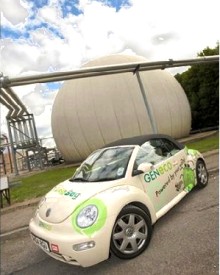 This little baby gets about 143 MPT (miles per toilet) |
When I was in grade school, I would – as I know many young boys probably still do – joke about how if we could just harness my friend’s seemingly never-ending compulsion to break wind, the world’s energy problems would be solved. As I grew older, this joke found new life in reference to the hot air of politicians who promote the myth of hope for America’s energy independence (see Robert Bryce’s Gusher of Lies
Public Transit Gets Personal
[ Comments Off ]Posted on August 5, 2010 by admin in Clean & Green
Thursday, August 5th, 2010Would you trade your car for this kind of personalized point to point mass transit?
 Okay. Maybe they’ll have to sex up the look a little. This DOES look kind of like an external hard drive for your Mac. |
As someone who for most of his adult life has thought of the personal automobile as one of the stupidest inventions in the history of mankind, I’m always looking for a convincing alternative to present to my oil-addicted car owner friends. It doesn’t help when clever Chinese engineers come up with creative but ultimately nutty ideas like huge rail-dependent “straddle buses” that cars can drive under (video below). And while the Commutapult is one creative idea for personal rapid transit, it’s perhaps a bit too rapid. Even if they do provide a stabilizer for your latte, as pictured here. In spite of the humor of that concept, the fact is that Personal Rapid Transit is probably the smartest, most viable idea out there that has any hope of replacing the automobile, or in some cases – like with the Synchrotrain concept – partially replacing it, while incorporating a sensible way for cars to ride piggyback. Personal Rapid Transit concepts are probably the only mass-transit ideas that have any hope of addressing that one big obstacle to public acceptance, i.e.: our ego-driven need to go where we want, when we want. There are a number of systems in various stages of planning and construction, and two systems actually in or near operation, one at Heathrow Airport and one in Morgantown, West Virginia. There are also arguments against the viability of these systems, but it seems fairly obvious to me that most who oppose the idea vehemently overlook what recent technology and innovative thinking can bring to the mix. What do you think? Would you give up your car to ride these things? Videos of various concepts below. Read the rest of this entry »
The Reality Of Green Realty
[ Comments Off ]Posted on July 8, 2010 by admin in Clean & Green
Thursday, July 8th, 2010When location, location, location might translate to off the grid, underground, in a shipping container.
 I might draw the line at actually living underground. |
I mentioned recently that a friend had scoffed at my dream of building a fully wired, off the grid home. Well, I figure if the US government can do it, anyone can. And I won’t be building a 222,000-square-foot facility like the one in that article. I’m shooting for something much smaller, though certainly not as small as say, an Ecopod, as cool as prefab and container-based designs like this can be. I’m planning to build from the ground up, which runs the risk of having a greater initial resource footprint, something I hope to offset by making the home so amazingly zero energy and integrated into the local environment – though not so integrated as to be literally underground – that this will be irrelevant in the long run. I have the good fortune to be on a ten year plan, and very willing to relocate, so I don’t anticipate this being an insurmountable problem. But obvious important factors will include finding the ideal location, selecting the best materials, and working with the best designers and builders, things I will definitely take the time doing as I assemble a business plan to seek funding. If you’re thinking about pursuing a green building venture yourself, there’s a wealth of information out there. For some starting points check out GreenYour.com’s How to Choose a Green Realtor, which has some good basic info that can help you assess if a realtor is really green, or just using green as a pitch. For a really in-depth look at whether you want to build new or renovate, where to build, materials to use, and even advice about considering the local community as much as your actual building site, check out this EPA Green Building page. And to find certified professionals and learn more about what their certs mean, check out Green Home Guide’s Find a Pro If you have any tips of your own, feel free to share. I have more daydreaming to do.