
Google Voice, iPhones, And SpyPhones
[ Comments Off ]Posted on August 8, 2009 by admin in Technology
Saturday, August 8th, 2009Google Voice is amazing. And creepy.
 I just got an invite to try Google Voice, and after giving it a quick test run, I was left a little uneasy. I’m not really a tin-foil hat type, but I’m often reminded of William Burroughs’ remark that “A paranoid is someone who knows a little of what’s going on”. The uneasiness kicked in as soon as I clicked on the “accept” link, and had to decide whether or not to use one of my existing G-Mail accounts. Should I use my business account? My personal account? I knew that to test the service, I’d be entering both my mobile and land line numbers. Which meant I’d be linking pieces of my Google search history with my e-mail content, two phone numbers, and my name. And storing it all in one place on a Google server. I opted to create a new G-Mail account. In spite of Google Voice’s amazing features, I’m going to have to ponder exactly how to put it to use, because the same things that make it cool make it creepy. You can record calls, transcribe them to text, do conference calls, and even pick up as someone leaves a voice message, just like an answering machine. All in one place. Which is exactly the issue. All in one place. On a Google server. I know we’ll all eventually have shaved heads, a number instead of a name, and be constantly under surveillance like in the George Lucas movie THX 1138
Twittergate – The Biggest Scoop That No-One Cares About
[ 2 Comments ]Posted on July 18, 2009 by admin in Technology
Saturday, July 18th, 2009The same public that doesn’t care about Twittergate probably doesn’t care about the ethics involved.
 TechCrunch’s Twitter Documents? A Little Bluerbird Told Them |
To me, the most interesting thing about the recent leak and subsequent publishing of secret internal documents from Twitter was not the information revealed about Twitter – we all know they fancy themselves to be in a deathmatch with Google and Facebook – but how TechCrunch’s decision to publish them raises once again a slew of questions about journalistic practices. The death of Walter Cronkite on Friday was a timely sort of metaphor for the kind of questions to which I’m referring; Cronkite’s famous We Are Mired In A Stalemate broadcast during the Vietnam war was a symbol of everything I admire about great journalists, and why, in decades past, I might have actually wanted to be one. TechCrunch’s decision to publish is an excellent 21st century example of 19th century British newspaper and publishing magnate Lord Northcliffe’s statement that “News is what somebody somewhere wants to suppress; all the rest is advertising“. After pointing out that Twitter is their largest source of outside traffic after Google in June, TechCrunch has turned around and bitten the hand that feeds them. Which raises a couple of interesting questions: Are they somehow upholding some value of journalism by informing the public, or are they merely capitalizing on a tremendous traffic generator? And will it backfire? While this is in fact one of the biggest stories no-one cares about (it was barely even a hot topic on Twitter, ironically), it still highlights one of the key problems faced by journalism which is outlined in one of my favorite books of the past few years, The Elements of Journalism
Google Autocomplete: Sex, Infidelity, Body Parts
[ 4 Comments ]Posted on June 4, 2009 by admin in Technology
Thursday, June 4th, 2009Google helps us ask the important questions, like…why do men have nipples?
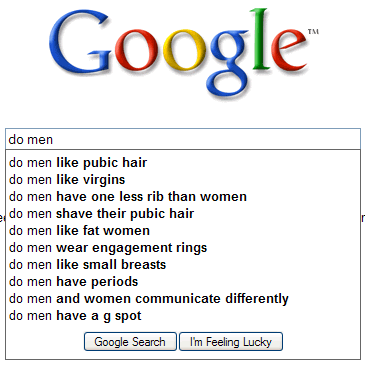
Google’s autocomplete function can provide some interesting insights into human thought and interpersonal relations. Below are just a few examples. Have any odd ones of your own to share? I had no idea that the most pressing “Why Do” question in the world was “Why do men have nipples”. And likewise, I’m surprised that neither gender seems to know if the other likes pubic hair. I’m even more surprised that this the number one suggestion for both. I’ve also always thought kissing was a nice simple thing. But no, it’s rife with suspicions of adultery and safety concerns. And c’mon guys. Why so much harsher than the women?







Is There Life After Facebook?
[ 2 Comments ]Posted on May 29, 2009 by admin in Technology
Friday, May 29th, 2009And are you tragically un-hip if you keep using it? Don’t worry. We have ideas for you.
 Well, apparently not, if you’re over 55. However, there are some interesting things going on out there. For one, Microsoft is launching Bing, their new “Decision Engine”. Make sure you understand the distinction, they’re worried that you’ll think it’s just another search engine. Nope, this one will make decisions for you. Finally. I’ve been waiting for something that does that. Although it’s easy to hate Microsoft, I’m personally looking forward to trying it. Google, for all its warm, fuzzy, Googliness, has become the bane of my existence when it comes to search. And what about Twitter? Well I and many people who are smarter than I am feel it’s already peaking. Which means, in a way, that it has a lot of life left in it, but some users will stay on board, many stop using it quickly, and most importantly, the hip people leave when the masses move in. Maybe the ability to search Tweets with tools like Topsy will broaden the interest. My bet? Back to the awesome Googliness. One of the main things that draws people and retains them with Facebook is the multitude of methods to interact easily. Unfortunately, Facebook fails rather miserably with things like chat functionality and a more versatile “inbox”, both of which should have been a no-brainer, in my opinion. A strong possible contender here is Google Wave, which, if they can bundle it all together flexibly with tools like Google Voice or PhoneVite would be a real winner. I would be ecstatic if a networking tool like Facebook allowed me to easily switch from a chat or inbox dialog to a cellphone voice or text dialog. So the questions arise. Am I pathetically uncool if I keep using Facebook? Where are you going after Facebook?
Why I’ll Never Get Paid To Write For Tech Industry Blogs
[ Comments Off ]Posted on May 20, 2009 by admin in Technology
Wednesday, May 20th, 2009I’m not a failed sports writer Googletard.
 |
 |
| Ask stupid sports questions and the little circle will twirl forever… | |
As someone who has to do a lot of research online for clients, I miss the early days of Google, not because I like Google so much, but because prior to Google’s monopoly on search, it was actually easier to find a broad variety of content, either by using multiple search engines (anybody remember Lycos? Alta Vista? Northern Lights?) or by letting a metasearch tool like Dogpile do it for you. Between blogs, Twitter, and Google’s monopoly, searching for useful content using Google can become quite a boolean chore. That’s why I’m always excited when a new tool like Wolfram|Aplha or Clusty comes along. And why I become so annoyed once again with Google’s dominance; easily half of the tech industry articles in the few days after Wolfram’s launch compared it unfavorably to Google (which is absurd, comparing the two is like comparing the card file at a library with the librarian), and a fair number of writers compounded their ignorance by testing Wolfram on the basis of its ability to spit out obscure sports facts. So knock it off, tech blog Googletards, Wolfram|Alpha isn’t meant to be Google. And keep your eyes peeled for the next search engine that’s doomed to fail because of being called a “Google Killer”, Microsoft’s Kumo (or will it be “Bing”?), which won’t be as much fun as Ms Dewey, but probably will be a little more useful.