
Global Power Elite? Yes. Masterminding Your Doom? Maybe not.
[ Comments Off ]Posted on February 14, 2013 by admin in Lifestyle & Culture
Thursday, February 14th, 2013You may not want to throw your tinfoil hat away, but you can at least take it off briefly to absorb some fascinating empirical data that demonstrates the shocking concentration of power in the world.
 Are you the sort of person who, as a result of reading lots of Noam Chomsky and pursuing rigorous internet research (i.e., spending hours on Prison Planet and InfoWars), have become aware of the vast global cabal that is masterminding control of the planet? You know, those less-than-one-percenters in the Bilderberg Group, Goldman Sachs, and the leaders at G8 meetings who control the future of 99% of humanity? Well, you can take your tinfoil hat off now. Because it turns out all your wingnuttiness was justified after all. At least in part. Today a friend (hi Kim!) tipped me off to some research that I missed over a year ago, in spite of the fact that it briefly went viral. I must have been frittering my time away at an Occupy meeting at the time, which is too bad; a lot of the research lends some weight to the whole 99% motif, and might have lent some rational thinking to the hyperbole and poorly-conceived strategy that characterized that movement in so many locales. As a person who is sort of addicted to information, and has always been fascinated with how the power in the world is actually structured, I was excited several years ago by collections like the Free Press’ Who Owns the Media , the Columbia Journalism Review’s Who Owns What, the Open Secrets Lobbying Database, and the graphical connections database website They Rule. That last one is especially fun, and it’s summarized here pretty well, if the interface doesn’t immediately make sense to you. But in spite of these amazing collections of data and the ability to peruse such a huge volume of information, I was always a little frustrated by the bias or poor visual presentation of collections like these. Which is why I felt sort of like a crackhead on a coca plantation today when my friend shared a link to Who controls the world? Resources for understanding this visualization of the global economy. That link is to the TED Talk summary of the amazing research done by Stefania Vitali, James B. Glattfelder, and Stefano Battiston . Part of what’s amazing about the research is that although the basic data was available, no-one had analyzed it this way before. They not only take massive amounts of empirical data, they do all the heavy lifting for you, so even an ignoramus like me can understand it. And what story does it tell? Well, Glattfelder shares it much more eloquently in his Ted Talk (video also below), but in a nutshell, it tells the story that the world’s wealth and power is in fact concentrated in the hands of a shockingly small number of stakeholders. And when I said at the top that your wingnuttiness was justified in part? Well, I was referring to the bit that may disappoint the more paranoid amongst us – the fact that there’s no empirical evidence of collusion amongst these key stakeholders. Oh well. Guess you’ll have to do your own sleuthing if you want to keep the paranoid flame burning. Video below. Read the rest of this entry »
Ten Best Cars for Driving Off a Fiscal Cliff
[ Comments Off ]Posted on November 11, 2012 by admin in Politics
Sunday, November 11th, 2012DC Gridlock usually prevents economic policy from moving from desk to desk, let alone off a cliff. But just in case, you may as well be prepared.
 Now that the presidential election is over, it’s clear that the media has decided that their favorite new buzz phrase will be “Fiscal Cliff”. It’s only been a week, and any sane person is probably sick of hearing it already. But what gives? Apparently the trillions of dollars in debt and deficits we’ve been running for years suddenly matter? Did the money printing machines break down or something? Someone please fill me in. Personally, I don’t see what all the panic is about. Given the gridlock in Washington, I can’t imagine how legislators are going to drive anything ACROSS TOWN, let alone off a cliff. But this got me thinking. If you were going to drive off a cliff, what would be the ideal vehicle? Below is a quick roundup. Read the rest of this entry »
Thrive: The Movie
[ Comments Off ]Posted on September 11, 2012 by admin in Lifestyle & Culture
Tuesday, September 11th, 2012Put on some popcorn and a tinfoil hat. Foster Gamble is taking you for a ride, in his doughnut-powered spaceship of libertarianism.
 Do you ever have a vague sense that something is just plain wrong with the world, and that there must be some unseen forces guiding things? That maybe there’s a group of powerful people connected to banking and large corporate interests that have an agenda for re-shaping the world to suit their desires? That behind the daily headlines we see, there’s a subtext that isn’t being revealed, and if it were, that a lot of global events would make more sense? If you do, and you’re looking for answers, you may want to watch the movie Thrive. Not because it offers any useful answers to these questions, at least sane ones. But there are a few things about the film that makes it worth a look. First of all, there’s the price. It’s free! You can view it right on the creator’s website (or on YouTube, if your prefer). That may in fact be the film’s strongest point. You may actually want to procure a copy though
Too Big To Jail
[ Comments Off ]Posted on August 19, 2012 by admin in Editorial & Opinion
Sunday, August 19th, 2012Why none of the crimes of the financial services industry will ever be punished.
 If you want to commit a crime and get away with it, one way to do it is to make it an EPIC crime, surround yourself with lots of fall guys, and remain utterly unrepentant. Nixon understood this in the Watergate scandal; his abuse of office was remarkable, and he had no qualms about letting his underlings dangle. Reagan & Bush understood this in the Iran Contra affair; mixing billion dollar drug and weapons deals to negotiate the extended enemy-state-sponsored kidnapping of American citizens to win an election was a stunning exercise in criminality that went largely unpunished. In fact one of their fall guys is now a high-paid “journalist” with Fox News. And in a recent bizarre example, the US government dropped charges against a fugitive doctor wanted in a multimillion dollar international racket selling prescription drugs online, simply because the evidence against him was using too much space on federal servers.
Another way to achieve your goal is to create a legitimate business that so insinuates itself into people’s lives that they feel they can’t live without it, and then charge them enough to buy deregulation for yourself, so you can basically get away with murder, price-fixing, repossession of property, Read the rest of this entry »
The Revolution Needs A Graphic Designer
[ Comments Off ]Posted on October 13, 2011 by admin in Lifestyle & Culture
Thursday, October 13th, 2011As soon as Occupy Wall St starts using professionally printed signs and posters we can assume the movement has been hijacked, but could we at least lose the “20th century Soviet” and “60′s Power Fist” motifs?
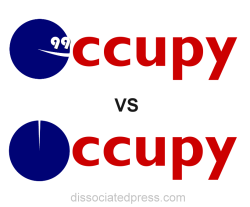 I’ve personally begun A-B testing for the revolution. |
If you’ve visited DissociatedPress.com with any regularity over the last few years, you know that I’ve been a bit annoyed with Wall Street since 2008 , when the industry built on gambling your hard earned dollars on sophisticated ponzy schemes to line billionaire bankers’ pockets with bonuses came tumbling down like a lost weekend in Vegas. Except when the hustlers lost their wad and woke up with a brain splitting hangover, they somehow managed to convince everyone to float them JUST ONE MORE TIME, swearing they’d mend their evil ways. Well, like any addict struggling with an addiction, they lied of course, slipped themselves a bunch more bonuses and wild parties just months later, and in the big picture, pretty much broke capitalism in the process. So it was with some excitement that I started watching the Occupy Wall St movement begin to gather steam last month; I even set up a site at OccupyAnnArbor.org, figuring if the movement didn’t arrive in my town on its own, I would HELP it arrive. No worries there though, within a few days of creating the site, about 1200 people had gathered spontaneously on one of the many Facebook groups that had suddenly popped up. Which is what I think the power of this movement is; it is genuinely grass roots and citizen-driven. People make fun of the cardboard signs being used at most gatherings, but to me those signs are a GOOD thing. As soon as we start seeing a lot of professionally-produced signs, we can probably assume the movement has been co-opted by a particular party or interest group. But that doesn’t mean we have to prove the “none of us is stupid as all of us” adage is actually TRUE. I think all the ninety-niners (see what I’m doing there?) should take a moment to read Frank Luntz’s Words That Work, and maybe Lovemarks, the brilliant book by Kevin Roberts about why we love the brands we love. The reason to read that first book is because Luntz helped the GOP understand the winning strategy of “it’s not what you say, it’s what people hear”, and the reason to read the second one is because it might help protesters understand that as much as using a black power fist makes you feel like you’re partying with Jimi Hendrix and Malcolm X, it makes the casual viewer think you’re a naive socialist who is out to undermine the American way of life. So while lots of artists like Shepard Fairey and Rob Sheridan are offering up free designs, I think even these talented designers are going a little too “oppressed laborer” with the imagery. So I’ve assembled a few images and ideas of my own about how to reframe the revolution a little. Feel free to chime in or share some interesting thoughts of your own, and if you’re looking for some inspiration, there’s a healthy collection of motifs here. Read the rest of this entry »