
Things Are Gettin’ Greener On The Server Farm
[ Comments Off ]Posted on October 26, 2011 by admin in Clean & Green
Wednesday, October 26th, 2011Did you know that two Google searches generate as much CO2 as boiling water on your stovetop? Big tech companies are finally taking bigger steps toward addressing their data center’s environmental impact, which often rivals that of entire cities.
 A couple of years ago, we talked about your Facebook Footprint, pointing out that two Google searches produce the same amount of CO2 as boiling water on your stovetop, and that Facebook has a carbon footprint equal to half of New York City. So have things changed much? You’d like to think that the brightest minds at innovative companies like Google would have a solid forward vision as they build the massive data centers that power the things that you do every day on the web, but do they? Well, it’s hard to tell. In spite of the fact that large tech companies like Google and Facebook don’t think YOU deserve much privacy, they treat information about their data centers like state secrets. None of the major tech firms in a Greenpeace roundup fared especially well, primarily because of a lack of transparency on the part of the companies in question. But it appears big tech firms are finally making SOME kind of effort. AMD and HP are partnering to explore the potential of solar-only distributed data centers. After considerable pressure, Facebook installed solar panels at their Oregon operation earlier this year, and suggesting maybe there’s some kind of financial sense to the idea (although this is a common argument against green energy) even Standard & Poors is getting in on the action. And Apple – in spite of being such an innovative company when it comes to devices and the revenue streams attached to them, is one of the late joiners in the game. For more comprehensive roundups if you’re interested, check out this special report from DataCenterKnowledge.com or this one from EcoFriend .
Dude Man, You Stole My Link, You Nazi
[ Comments Off ]Posted on October 22, 2011 by admin in Lifestyle & Culture
Saturday, October 22nd, 2011The death of netiquette and the decline of quality of life on Facebook.
 Facebook may never actually die, but the neighborhood sure has gone to hell. |
One of the interesting things about social networking is that one of its key components – threaded discussion or comments – has been around since before the web even existed, beginning with the CBBS’s of the late 70′s. Like so many of the fine things in life though – like espresso drinks, literature, and proper grammar – once the commoner got involved, it all went to hell. I personally first noticed a serious decline in the quality of internet life around 2005. This of course was the year that MySpace first rose to prominence, but we can’t blame it all on sparkly animated unicorn graphics. It was also the year that “blog” became a household word (it was Merriam-Webster’s word of the year in 2004), the year that broadband access surpassed 50% of the US population, and the year that Google achieved near-total dominance of search, and made AdSense the most popular method of easy revenue generation on the web. This meant that at exactly the point where all the mouth breathers were finally getting on the web, they also had a readily-available way to self-publish, and two incentives to do so. First, an arrogant confidence in their ill-conceived beliefs fueled by watching Bill O’Reilly, and second, the ability to monetize their mindless rants by sticking ad content in their sites and spamming Google with SEO tricks (we’ve talked about content farms before). When you begin to look at the numbers for all the available ways to self publish – 800 million Facebook users, 200 million Twitter users, 150 million blogs (growing rapidly, by the way), and presumably another few hundred million Tumblr, LiveJournal, Flickr, and YouTube accounts – you realize that we now have as many content creators as consumers amongst the web’s 2 billion or so users. NO WONDER the whole concept of web courtesy known as netiquette has gone out the window. WE’RE ALL EXPERTS, goddamit, so SFTU LOL. Tell me you haven’t experienced one of the following things on Facebook: You share a really cool link, and your “friend” reposts it without a “via” or “hat tip” and gets more comments than you did, leaving you a little grumpy. You get engaged in a dynamic political dialogue, and suddenly find your blood boiling as it devolves down to a two or three person argument with massive paragraphs of polarized ranting. You post the coolest link that’s ever been posted on the web, and not a single person comments. Or maybe you share a link to an article about starvation in Somalia, and people “Like” it instead of commenting. These are all examples of things that I think have diminished the quality of the Facebook experience for many of us, and they all could have been easily avoided if people understood the basic principles behind the archaic concept of netiquette. And I realize that addressing “the Facebook experience” in a serious way seems almost comical, but let’s face it – millions of us check Facebook as or more often than we check email, and it’s a small but significant part of what may shape your mood in the morning. But it’s probably too late now; people more than ever are far more interested in their own thoughts than others’, and the analogy of Facebook and a civilized threaded discussion has one big weakness: good discussion boards have moderators, and the only moderators on Facebook are 400 million morons. I think I’m being kind here, I’m saying that more than half of Facebook users AREN’T morons, and I think you can agree that’s being pretty generous. So it’s probably too late for Facebook, but just in case you get sucked into the NEXT social network – assuming there is one – below are a few of the old netiquette terms and principles that might make the experience a little more enduring and enjoyable. Me, I’m boycotting Facebook until they enable sparkling animated GIF’s. Read the rest of this entry »
Internet Insecurity
[ Comments Off ]Posted on March 24, 2011 by admin in Technology
Thursday, March 24th, 2011After the recent breaches of ultimate, top-level security resources like RSA and Comodo, giving sites like Facebook twice as much info for “enhanced security” seems like a faulty strategy.
 Earlier today I had an experience that reminded me that – like many of us – I should really get more on top of managing my various internet accounts and their passwords better than I do. I was trying to log in to my YouTube “Director” account, and YouTube was trying to link the account to a Google acccount. I wouldn’t have minded this, except when I tried to link the Google account and the YouTube account – which had the same username, by the way – YouTube would tell me that the account was already linked to another Google account, which it wasn’t. After twenty minutes of password resets and cookie deletions, I finally managed to log in to my own account. And then GMail suggested I add additional user information as part of Google’s interpretation of Two-factor authentication. I opted not to do so. Why? Because I simply don’t believe that either Google or Facebook (which is trying to do the same thing by asking for your phone number as part of your account verification) is enacting these programs strictly for security purposes. Both Mark Zuckerberg of Facebook and Eric Schmidt of Google are on record as saying that they don’t believe that privacy is in your future, that anonymity is intrinsically bad (Zuckerberg has hilariously said “Having two identities for yourself is an example of a lack of integrity”), and that we all need a verified identity on the web. This would make a lot of sense if you could in fact trust any web service to absolutely protect the information you gave them, but you can’t. In just the past week, two of the web’s ultimate sources of security verification – RSA and Comodo – have been hacked, a breach that Comodo’s own CEO Melih Abdulhayoglu likened to a web version of the September 11 attacks. And this of course is all hot on the tail of the well-publicized “Anonymous” attack of security firm HBGary. I’m no security expert, but I’m perfectly capable of thinking like a criminal. And my criminal mind tells me that giving twice as much information to an entity I can’t trust – i.e. any web-based service – really leaves me twice as vulnerable in the event that the entity is compromised. Which it almost certainly will be some day. I have made a casual but consistent effort to keep my online identity usefully accessible, without sharing my entire identity in one place, and will continue to do so. Common sense tells me that one-point interactions with services like Google, Facebook, banks, and other services, with a variety of e-mail accounts and varied passwords, is a decent strategy. But I think I need to ramp things up a bit. This article about password usage on Lifehacker – while screaming with irony because Lifehacker was one of the sites hacked when Anonymous went after Gawker – does hit on some key points. The author says he has 90+ accounts to manage. I’d put my number closer to 30, although if I add the accounts of clients, it may be more like 50 or 60. I’m beginning to do a bad job of managing them all, but plan to tighten things up where I can. At least I don’t use any of the 500 most common passwords. What about you? Do you trust sites like Google and Facebook with your full name, phone number, and other personal details? Or do you keep things closer to the chest?
Assimilated By Facebook – Is Resistance Futile?
[ 4 Comments ]Posted on February 24, 2011 by admin in Lifestyle & Culture
Thursday, February 24th, 2011I would have never discovered the disturbing similarities between Facebook and the Borg if I hadn’t tried to escape “the collective”.
 Have you been assimilated yet? You may not have even noticed it happening. Do you have shadowy memories of a previous life in which you didn’t check Facebook every morning when you woke up? When you didn’t think in status posts, putting yourself in the second person to construct clever phrases like “John or Jane Doe is [insert comment-baiting one-liner]? When you didn’t feel vulnerable and afraid when the hive mind was not humming around you sharing their thoughts in a constant stream intermingled with your own? My little joking analogy here isn’t so far off base. We’ve asked before if the internet is actually a giant flesh-eating robot, but we think it may be worse. Facebook may actually be controlled by the Borg. If you’re a normal human, with your life firmly rooted in the real world, you will have no idea what I’m talking about. But if you’re a person who spends a fair amount of time on the web, you have almost certainly at some point found yourself – and perhaps still are – spending an awful lot of time interacting with Facebook. Early on, we would wonder to ourselves: “am I weird? Am I the only person who feels like some kind of Facebook addict? Personally, when I validated this feeling with my friends who pondered the same question, it only made me feel like they were weird too; it didn’t provide much comfort. But the results are in, so we can stop second-guessing ourselves. Yes, it’s a problem. We now know that a third of women 18-34 check Facebook when they first wake up, even before they go to the bathroom . We know that serious addiction sites label it a problem, as do PhD Psychologists. As far as I’m concerned, this is a moot point. What concerns me is the fact that Facebook bears such a disturbing resemblance to the Borg, and there may be NO WAY to escape the collective. Recently I thought I’d at least give Facebook a rest, but still found myself unconsciously logging on, to find that nothing new of interest awaited me – the same banal stream of commentary, the same pleas to support liberal or conservative causes from my friends. And nobody commenting on my crap. That’s the killer. When the little red number is low, and only indicates comments on other people’s stuff. How depressing. So why the hell was I reflexively logging in for more letdowns? Probably because I’m a Faceborg Drone, that’s why. I thought to myself “Wow, I think I’m going to have to actually de-activate my account for a few days, and go back when I feel more rational about the whole thing“. But no-OO-oo. Facebook tried to scare me with images of the fellow drones I’d be abandoning, and actually wouldn’t LET me de-activate unless I assigned another person (who is on Facebook) to manage a couple of apps or pages connected to my account. DIRTY TRICK, Facebook. But I expect nothing less from what I now know is an alien collective that intends to “add my biological and technological distinctiveness to its own“. Below are examples of how Facebook is like the Borg, and how hard they make it to escape the hive. More soon, I have to go share this piece on Facebook now. Read the rest of this entry »
Facebook To Demand DNA Sample For Log In
[ Comments Off ]Posted on January 5, 2011 by admin in Technology
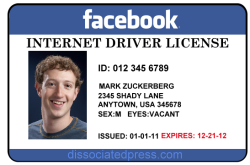
Wednesday, January 5th, 2011In addition to the blood of your firstborn, a retinal scan, and other biometric methods. Do you trust Facebook to be the issuer of your “Internet Driver’s License”?
 Sometimes I feel like I’m Charlton Heston’s character in Soylent Green
