« Older Entries |
[ Comments Off ]Posted on September 11, 2012 by admin in Lifestyle & Culture
Tuesday, September 11th, 2012
Put on some popcorn and a tinfoil hat. Foster Gamble is taking you for a ride, in his doughnut-powered spaceship of libertarianism.
 Do you ever have a vague sense that something is just plain wrong with the world, and that there must be some unseen forces guiding things? That maybe there’s a group of powerful people connected to banking and large corporate interests that have an agenda for re-shaping the world to suit their desires? That behind the daily headlines we see, there’s a subtext that isn’t being revealed, and if it were, that a lot of global events would make more sense? If you do, and you’re looking for answers, you may want to watch the movie Thrive. Not because it offers any useful answers to these questions, at least sane ones. But there are a few things about the film that makes it worth a look. First of all, there’s the price. It’s free! You can view it right on the creator’s website (or on YouTube, if your prefer). That may in fact be the film’s strongest point. You may actually want to procure a copy though
 , simply to be able to review its bizarre fusion of sane progressive thought and tinfoil hat insanity at your leisure. The film was assembled by a fellow named Foster Gamble, a member of the “legacy” family from the Gamble side of Proctor & Gamble empire. Gamble exudes a disturbingly genuine sincerity as he guides the viewer through topics ranging from crop circles and UFO’s to the evils of the Federal Treasury, the Rothschild and Rockefeller families, and the Illuminati. And he does it all with a weird pseudo-scientific presentation, mixing references to toroidal free energy innovations that are allegedly Read the rest of this entry »
[ Comments Off ]Posted on October 19, 2011 by admin in Popular Media
Wednesday, October 19th, 2011
What has 224 legs, 336 eyes, takes 5 years to mature, and lives for 95 minutes? One of the most thought-provoking films you’ll ever see, Problema.

An aerial view of the “set” of Problema
|
What would happen if you rounded up thought-provoking questions from people all over the world, then gathered about a hundred thoughtful people together in a huge circle, pointed cameras at them, and asked the questions one by one? Well, a cacophonous murmur would probably ensue, until you edited the results into some kind of cohesive whole, as director Ralf Schmerberg did with his epic film project Problema. The project was inspired by the Dropping Knowledge project, a global information sharing and media project founded in 2003. On a single day in September, 2006, over a hundred individuals – artists, scientists, writers, business people, and other thinkers – took their place around a huge circle in Berlin’s Bebelplatz. This was a powerfully symbolic choice – the Bebelplatz was the location of the infamous Nazi book burnings of 1933. With digital cameras pointed at each guest, hosts Willem Dafoe and Hafsat Abiola (founder of Nigeria’s Kudirat Initiative for Democracy) asked 17 of 100 questions that had been selected from the thousands that were submitted worldwide via the Dropping Knowledge project. The guests then responded in their own time, with the cameras all running continuously, all framing the guests in a tight headshot. Guest Wim Wenders – director of the film Wings of Desire – astutely pointed out the similarity between the resulting murmur and the way the angels in his film had no choice but to hear the thoughts of humans everywhere, which created much of the lush sonic backdrop of Wings of Desire. Schmerberg – Problema’s director – managed to capture much of this live feeling of the event by interspersing compelling, sometimes tear-inducing images with a lively mixture of both concise, eyes-at-the-camera answers, and almost out-take-like moments of verité in which the attendees fumbled with their thoughts or spoke in asides to the guests sitting next to them. The result is a thought-provoking documentary unlike any you’ve seen before. If you’re a caring person who lives in the so-called “First World”, a question like “Does our wealth depend on the Third World being poor?” might make you think “Well of course, and it’s a shameful tragedy”. But you’ll suddenly be forced to ponder things like what a bogus concept the “Third World” is in the first place, or how much freedom you have if you live in a powerful western capitalist country, when a sophisticated, educated person from Colombia points out that he for instance is only able to visit a place like Berlin because of a four day visa connected with the making of the film. He otherwise is barred from our “first world” as a second-rate global citizen who “has no right to enter our paradise” as he puts it. Although you may find Problema quite watchable on your own, you might find it a lot more interesting if you watch it with some intelligent friends, so you can discuss the world of questions it is likely to raise in your heart and your head. To view the film as a particapatory event, the Problema website offers a screening page that allows you to publicize the event, but you can just download it and watch it with friends if you like – it’s free, provided in multiple file formats, and can be downloaded by bittorrent or as a direct file.
[ Comments Off ]Posted on March 14, 2011 by admin in Popular Media
Monday, March 14th, 2011
If you have three hours to kill and love German electronic music, this Kraut Rock doc will knock your socks off. And if you just don’t have the attention span, you can always pick up Kraftwerk’s new “Kling Klang Machine” iPhone app.
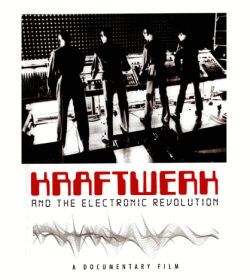 
If you don’t have the attention span for
the documentary, maybe you should just
get the unrelated Kling Klang iPhone app. |
If by chance you spent any time in a nightclub in the last thirty years, there’s a fairly good chance that you owe what your feet were doing either directly or indirectly to the band Kraftwerk. From their early experimental work that led to the more commercial Autobahn and Radio-Activity
 in the mid 70′s, right through their infectious and often re-mixed machine pop of the 80′s, Kraftwerk’s music helped shape the entire Punk/alternative waves of the 70′s and 80′s. In part by helping inspire Bowie and Eno to move to Berlin, and in part by creating the basic template for the sounds of tunes like Donna Summer’s “I Feel Love”
 and bands and artists like Gary Numan
 , Depeche Mode, Orchestral Manoeuvres in the Dark, and Human League, to name just a few. And it’s probably safe to say that entire genres – like techno, industrial, and house – would not later even exist if it weren’t for Kraftwerk’s innovations in electronic pop and dance music. Hell, without Kraftwerk, Sprockets itself would be impossible. And then whose monkey would we touch? I’m stating the obvious here, mostly for any ignorant young hipsters reading that haven’t pieced these facts together yet. My own experience with Kraftwerk began as a teen, being transported to alternate realities by the sonic landscapes of tunes like “Autobahn” (with perhaps a little neurochemical assistance), which inspired me to become a fairly obsessive synthesist myself in an era before electronic pop really even existed. It’s important to note that while artists like Wendy Carlos were creating their brilliantly elaborate, but still bleepy and sqawky works like Switched-On Bach
 , Kraftwerk was creating electronic pop music so listenable and evolved in its sensibilities that artists like Eno have described it as “nostalgia from the future”. And Kraftwerk’s brilliantly simple marketing themes – from the slyly uber-teutonic Autobahn album cover with its iconic Mercedes Benz and Volkswagen cruising through the rolling hills of a Germanic dreamland, to their later images that implied – but directly never mentioned – the coldly intellectual clean cut scientists of World War II Germany – have helped maintain a peculiar mystique around the band for decades. I mean, have you ever actually seen or heard zee operator wiss zee pocket calc-u-lator speak in an interview? Probably not, unless you stopped by KlingKlang Studio in Dusseldorf and caught them in. The studio doesn’t even have a phone, according to this Guardian piece that explores the band’s press stealth, but manages to illicit “I got a new head, and I’m fine“. But enough of my sycophantic drivel, I really just wanted to suggest that if you have three hours and an obsessive interest in the intricate details of Kraftwerk’s evolution, you should check out Kraftwerk and the Electronic Revolution. It explores the entire German electronic music scene from the 60′s through to the 80′s, with Kraftwerk as a main course but with fairly hearty (and probably necessary) side-dishes of Popol Vuh, Tangerine Dream, Amon Duul and Neu! If you’re REALLY into Kraftwerk, you may have already seen it; it’s been out since 2008. I personally only discovered it the other day. I recommend watching it as a mini-series though; three straight hours of in-depth commentary and analysis was a bit much even for a lifelong fan like like myself. It’s already a great deal as an on-demand DVD, but there’s also a $2.99 download
 . And if you simply don’t have the attention span, maybe you should just get their new iPhone app, released last week.
Read the rest of this entry »
[ Comments Off ]Posted on April 13, 2010 by admin in Popular Media
Tuesday, April 13th, 2010
Now I know what the “BS” stands for, but what about the “P”?
 Whether you’re a conservative or a liberal, watching the PBS Frontline program Obama’s Deal may leave you with some rather muddled feelings. If you’re an Obamaphile, you’ll jump to the president’s defense saying “Yeah, well, it’s Washington. There have to be some dirty deals made to get anything done“. If you’re a conservative, you’ll probably be left scratching your head, saying “Jeez. I had NO IDEA this guy was so COOL“. The program comes across as a low-key indictment of the methods president Obama utilized to drive home his health care “victory”. Which I find a little ironic. Not that I think they’re wrong in their highbrow, liberal elitist tsk-tsking observation that Obama is in fact “just another politician”, and for mostly political reasons has just done more to benefit the insurance companies than he has to benefit the American people. No, it’s the fact that – as much as I love the brilliantly produced show – to bother with this topic at all is a sort of meta-ironic commentary on the sad state of investigative reporting itself. I mean, where was their “investigative reporting” when this was all going down? It’s sort of like if we all knew that Nixon was a conniving manipulative bastard who would do anything to achieve his ends, so engineered and executed the Watergate burglaries with public transparency, and then Woodward & Bernstein came along and reported it on it. Sorry Frontline, I love you. But if this is your idea of news, I’ll stick with the Daily Show.
[ Comments Off ]Posted on March 18, 2010 by admin in Popular Media
Thursday, March 18th, 2010
I think we’ve been worrying about the wrong Big Brother.

I think this poster has it backwards |
Quite some time ago, San Francisco radio figure Wes Nisker said If You Don’t Like the News, Go Out and Make Some of Your Own . Apparently Rupert Murdoch, Jack Welch, and other media moguls took his advice. I’ve been fascinated with the literally Orwellian evolution of media control in America over the past decade or two that began in earnest with the deregulation of the Reagan years and has resulted in ten or fewer media companies owning everything. Which is a bad enough thing in itself, but gets really bad when those same companies control the government as well. As a well-conditioned media consumer, I was so busy Facebooking about my emotional knee-jerk reactions to liberal and conservative media pundits that I had forgotten that this behavior of mine was all part of a vast Orwellian 21st century robber baron plan. That is, until I was reminded of this fact last week when I finally saw the 2005 documentary Orwell Rolls in His Grave
 . It’s a shame that the makers of the film didn’t package the product a little differently; the title gives off a paranoid post 9/11 vibe that detracts from the substance of the film, which is an insightful exploration of the corporate media dominance of what you see, read and hear as a result of influence peddling and Washington’s unprecedented revolving door policies of late. Much like Noam Chomsky’s Manufacturing Consent
 , the film wallows a bit too much in what seems like academic hand-wringing, and plays the Orwell angle a little too hard. The fact is that Orwell wouldn’t be rolling in his grave, because the film effectively makes the case that we’re living exactly the way Orwell envisioned things. I’d still recommend the film, and if you’re interested in this topic, the totally unrelated book The The Elements of Journalism
 , which explores a similar topic, i.e.: the failure of journalism as a result of the purely profit-driven decision making that has replaced “real” news with entertainment. I sometimes lament that most whistleblower-oriented documentaries – like Food, Inc.
 , Outfoxed
 , and virtually anything by Michael Moore – end up coming across as liberal whining in the end. It would be inspiring if someone managed to produce a less partisan documentary that just looked at the apalling truth of it all. Yes, the Bush White House that was brought to us by Project For A New American Century was indeed Orwellian in its lies and doublespeak, but the real evil is not the party they claimed to represent, it’s the pathological behavior of the media companies that seek control of government through agency capture. America *needs investigative journalism, hard hitting documentaries, and gutsy exposés more than ever right now. But don’t expect to see them in a major theater in an era when Disney blocks the distribution of a Michael Moore film for telling too much of the truth about George Bush. Fortunately, at least for now, we have the Internet, so you can watch entire films like Orwell Rolls in His Grave on line . Read the rest of this entry »
